PM Surya Sarovar Yojana 2026: ₹5,070 Crore Floating Solar Scheme Targets 5 GW Capacity
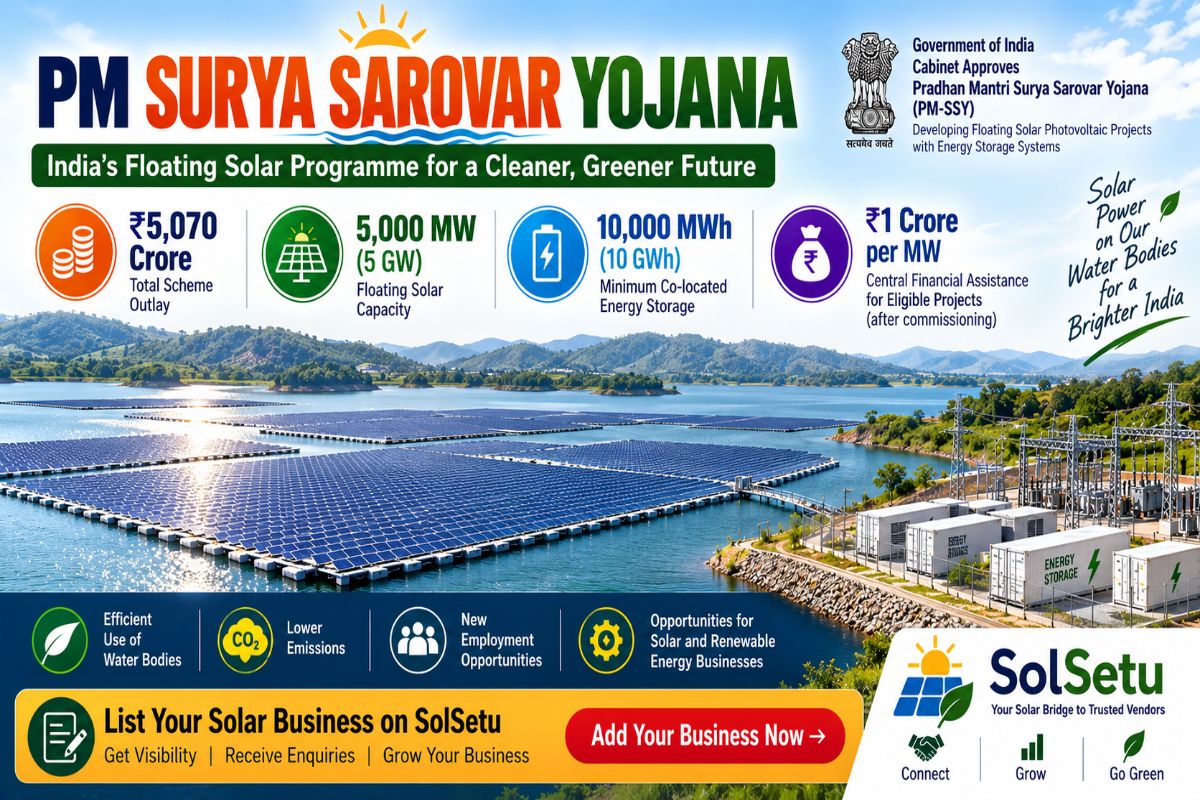
India is preparing for a major expansion of floating solar power with the Pradhan Mantri Surya Sarovar Yojana (PM-SSY), an approved government programme with a total outlay of ₹5,070 crore. The scheme aims to develop 5,000 MW of floating solar photovoltaic capacity alongside battery energy storage systems, opening new opportunities across India's renewable-energy industry.
Approved by the Union Cabinet on 31 July 2026, the programme is designed to make productive use of existing reservoirs and suitable inland water bodies while reducing pressure on scarce land resources.
The initiative also integrates energy storage into floating solar development, helping address the challenge of matching variable solar generation with electricity demand.
☀️ Are You a Solar or Renewable-Energy Business?
Floating solar projects create opportunities for EPC contractors, solar module suppliers, electrical contractors, battery-storage companies and renewable-energy project developers.
What Is the PM Surya Sarovar Yojana?
The Pradhan Mantri Surya Sarovar Yojana (PM-SSY) is a government scheme for developing floating solar photovoltaic projects integrated with energy storage systems.
Unlike conventional ground-mounted solar farms, floating solar installations place photovoltaic panels on buoyant platforms anchored to suitable water bodies.
The approach can make productive use of existing reservoirs and industrial ponds where technical, environmental and regulatory conditions permit.
Under PM-SSY, the government aims to support 5 GW of additional floating solar capacity, with co-located energy storage having a minimum total capacity of 10,000 MWh.
PM Surya Sarovar Yojana: Key Highlights
| Scheme Detail | Target or Allocation |
|---|---|
| Total scheme outlay | ₹5,070 crore |
| Floating solar capacity | 5,000 MW (5 GW) |
| Minimum energy storage capacity | 10,000 MWh (10 GWh) |
| Minimum storage duration | Two hours |
| Central financial assistance for eligible projects | ₹1 crore per MW after successful commissioning |
| Feasibility-study assistance | Up to ₹50 lakh per project |
| Project sanction period | FY 2026–27 to FY 2030–31 |
| Financial support disbursement period | Through FY 2032–33 |
| Estimated national floating solar potential | Approximately 102.18 GWp |
These figures are based on the Government of India's Cabinet announcement. Financial assistance is subject to the scheme's applicable eligibility requirements and implementation guidelines.
Why Is India Investing in Floating Solar?
India needs additional renewable-energy capacity to support rising electricity demand, improve energy security and advance its clean-energy objectives.
However, large ground-mounted solar projects require land, and land availability can be a constraint in densely populated or agriculturally important regions.
Floating solar provides an alternative approach by using suitable existing water bodies rather than relying exclusively on additional land.
Potential locations include:
- Suitable irrigation reservoirs
- Hydroelectric reservoirs
- Industrial water ponds
- Other eligible inland water bodies
Not every reservoir is suitable for floating solar. Water use, seasonal water-level changes, anchoring conditions, aquatic ecology, dam operations and grid connectivity must be assessed before a project can proceed.
What Is Floating Solar Technology?
Floating solar, also known as floating photovoltaic (FSPV) technology, uses solar panels installed on floating structures rather than conventional ground-mounted support systems.
A typical floating solar project includes:
- Photovoltaic modules
- Floating platforms and support structures
- Anchoring and mooring systems
- DC cables and electrical connections
- Inverters and power conversion equipment
- Water-compatible electrical protection systems
- Underwater or shore-connected power cables, as required
- Grid interconnection infrastructure
- Monitoring and control systems
The engineering design must account for water-level variation, wind loading, wave conditions, moisture exposure and long-term durability.
How Will Battery Storage Support Floating Solar?
One of the distinctive features of PM-SSY is the integration of energy storage with floating solar projects.
Solar generation varies throughout the day and can be affected by clouds and weather. Battery energy storage systems can store electricity when it is available and release it later, subject to the project's operating strategy and grid requirements.
The scheme envisages at least two hours of co-located energy storage, with a total planned storage capacity of 10,000 MWh.
Potential benefits include:
- Improved grid flexibility
- Better management of peak electricity demand
- Shifting some solar electricity to later hours
- Improved coordination between renewable generation and demand
- Support for more reliable electricity-system operation
Actual performance depends on battery power ratings, usable energy capacity, charging opportunities, efficiency, degradation and dispatch requirements.
How Much Government Assistance Is Available?
Under the announced scheme, eligible floating solar photovoltaic projects can receive Central Financial Assistance of ₹1 crore per MW after successful commissioning.
Additional assistance of up to ₹50 lakh per project is available for eligible feasibility studies and preparatory activities.
These activities can include:
- Bathymetric surveys to assess water-body depth and underwater terrain
- Hydrographic assessments
- Environmental studies
- Other eligible project-preparation activities
The support is intended to reduce project-development risks and encourage floating solar deployment.
Important: These announced assistance levels should not be interpreted as an unconditional subsidy for every company, landowner or proposed floating solar project. Applicants must satisfy the applicable scheme conditions and follow the designated implementation and approval process.
What Is India's Floating Solar Potential?
The National Institute of Solar Energy (NISE) has estimated India's floating solar potential at approximately 102.18 GWp across reservoirs and other suitable inland water bodies.
This estimated technical potential is substantially larger than the 5 GW capacity targeted under PM-SSY.
However, technical potential does not mean that every site is economically viable or available for development. Each project requires site-specific assessment, environmental review, engineering design and the necessary approvals.
Expected Environmental and Employment Benefits
The government expects the scheme to help reduce approximately 10 million tonnes of CO₂ emissions annually and generate around 16,000–17,000 full-time-equivalent employment opportunities across the project value chain.
Floating solar may also reduce competition for scarce land and create opportunities to use suitable existing water bodies for renewable-energy generation.
Potential employment areas include:
- Project development and engineering
- Floating-structure manufacturing
- Solar module and equipment supply
- Electrical installation
- Battery storage integration
- Construction and commissioning
- Monitoring and maintenance
Actual environmental and employment outcomes will depend on project implementation, electricity generation, grid displacement and local supply-chain participation.
Opportunities for Solar EPC Companies
PM-SSY could create a specialised market for businesses with experience in floating solar, electrical infrastructure and battery energy storage.
Potentially relevant companies include:
- Floating solar EPC contractors
- Solar PV module suppliers
- Floating-platform manufacturers
- Anchoring and mooring-system suppliers
- Inverter and electrical-equipment suppliers
- Battery energy storage integrators
- Power conversion system providers
- Substation and transmission contractors
- Environmental and engineering consultants
- Testing, commissioning and O&M providers
Companies should review the actual procurement notices and qualification requirements before making investment or bidding decisions.
Opportunities for Battery Storage Businesses
Integrating battery storage with floating solar creates opportunities beyond the solar modules themselves.
Businesses working in battery systems, power electronics, battery management, energy management software and electrical engineering may find relevant opportunities as projects are developed.
However, the size of the market available to individual companies will depend on project allocation, procurement rules, technical requirements and competition.
Key Challenges in Floating Solar Development
Floating solar offers important advantages, but it requires specialised engineering and careful site selection.
1. Water-Level Variation
Seasonal reservoir-level changes can place stress on anchoring, mooring and cable systems. Designs must account for the expected range of operating conditions.
2. Environmental Protection
Large installations can affect sunlight penetration, aquatic habitats and water-body use. Environmental assessments and appropriate project design are essential.
3. Corrosion and Moisture
Equipment must be suitable for long-term exposure to moisture and the conditions at the project site.
4. Grid Connectivity
Suitable evacuation infrastructure is necessary to deliver generated electricity to the grid. Transmission distance and interconnection costs can affect project economics.
5. Project Financing
Floating solar involves specialised structures, surveys, anchoring and electrical systems. Developers must evaluate total lifecycle costs and project revenues rather than relying only on announced financial assistance.
What Should Renewable-Energy Businesses Do Next?
Businesses interested in floating solar and battery storage can start preparing by:
- Developing floating solar engineering capabilities
- Identifying qualified equipment and technology partners
- Building project credentials and technical documentation
- Monitoring official scheme guidelines and tenders
- Assessing relevant reservoir and industrial-pond opportunities
- Developing battery-storage integration capabilities
- Reviewing environmental and water-body approval requirements
- Maintaining a professional online business profile
Project-specific eligibility and tender conditions should always be checked against official documents issued by the relevant authorities.
Grow Your Renewable-Energy Business with SolSetu
As India's floating solar and battery-storage sectors expand, project developers and customers need ways to discover qualified renewable-energy suppliers and service providers.
SolSetu — Your Solar Bridge to Trusted Vendors helps solar and renewable-energy businesses showcase their products, services, project experience and capabilities.
- Professional business profile
- Product and project showcase
- Improved online business visibility
- Customer enquiry opportunities
- WhatsApp and email lead alerts
- Verified Vendor Badge, subject to applicable requirements
- Priority Search Placement, subject to plan terms
Plans start from ₹999 for 30 days.
👉 Add Your Solar Business on SolSetu
Conclusion
The Pradhan Mantri Surya Sarovar Yojana represents a significant step toward expanding floating solar power in India.
With a ₹5,070 crore outlay, a 5 GW floating solar target and 10 GWh of planned energy storage, the scheme is designed to encourage renewable-energy development on suitable existing water bodies.
Its success will depend on effective implementation, careful environmental management, reliable engineering, battery integration and transparent project procurement.
For solar EPC contractors, floating-platform manufacturers, battery-storage businesses and renewable-energy suppliers, PM-SSY is an important programme to monitor as the official implementation process advances.
☀️ Be Part of India's Floating Solar Growth
Showcase your products, engineering services and renewable-energy capabilities to customers through SolSetu.



Leave a Reply