PM-KUSUM 2.0: 10 GW Agri-PV Opportunity for Farmers and Solar Industry
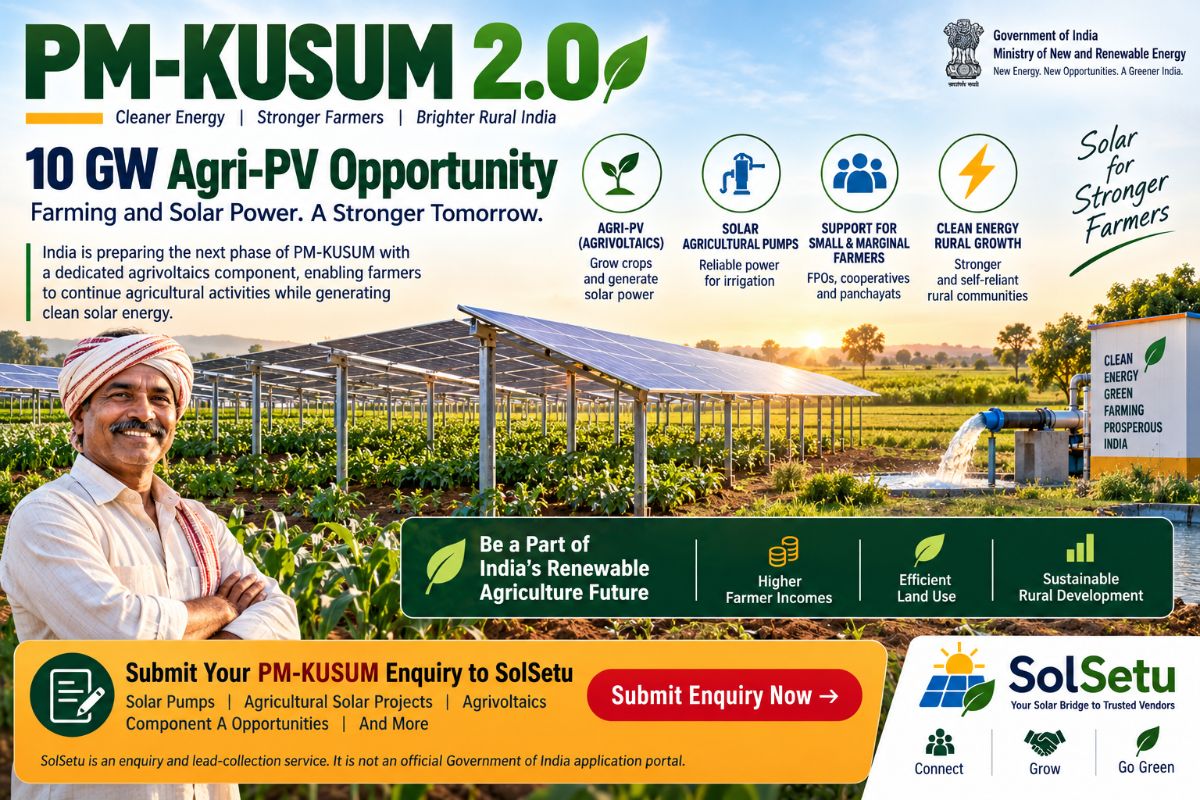
India is preparing the next phase of PM-KUSUM with a dedicated focus on agrivoltaics, creating a potential new opportunity at the intersection of agriculture and renewable energy.
The Government of India has announced that the next phase of the Pradhan Mantri Kisan Urja Suraksha evam Utthaan Mahabhiyaan, commonly known as PM-KUSUM 2.0, will include a dedicated component for agrivoltaics or Agri-PV.
According to the latest government update, the next phase is intended to enable farmers to continue agricultural activities while also generating electricity from solar installations on the same land.
☀️ Interested in PM-KUSUM 2.0?
Farmers, landowners, FPOs, cooperatives, panchayats and solar project developers can submit their PM-KUSUM-related requirements to SolSetu.
SolSetu is collecting enquiries to understand demand for solar pumps, agricultural solar projects, agrivoltaics and other PM-KUSUM-related opportunities.
What Is PM-KUSUM 2.0?
PM-KUSUM 2.0 refers to the next phase being prepared by the Government of India to expand the role of renewable energy in agriculture.
The existing PM-KUSUM programme focuses on solarisation of agriculture through decentralised solar power plants, standalone solar agricultural pumps and solarisation of grid-connected agricultural pumps.
The proposed next phase is expected to place greater emphasis on agrivoltaics, allowing agricultural production and solar electricity generation to coexist on suitable land.
Important: PM-KUSUM 2.0 should not be confused with an ordinary private solar project or treated as an open government application process. Farmers and businesses should verify the final eligibility rules, state-wise implementation mechanism and application process through the relevant government authorities when notified.
10 GW Dedicated Agri-PV Component
One of the most significant announcements surrounding PM-KUSUM 2.0 is the proposed 10 GW dedicated Agri-PV component.
The government has described Agri-PV as a model in which solar panels and agricultural activities can coexist on the same land.
This could create a new renewable-energy model for rural India by combining:
- ☀️ Solar electricity generation
- 🌱 Agricultural production
- 💧 Irrigation infrastructure
- ⚡ Decentralised renewable power
- 👨🌾 Additional potential income opportunities for farmers
What Is Agrivoltaics?
Agrivoltaics, also known as Agri-PV, is the practice of combining solar photovoltaic systems with agricultural activities.
Instead of using land exclusively for solar power generation, appropriately designed systems can allow crops or other agricultural activities to continue underneath or between solar structures.
The exact design depends on the crop, climate, solar structure, irrigation requirements, land characteristics and applicable regulations.
Why PM-KUSUM 2.0 Could Be Important for Farmers
India has a large agricultural economy and significant electricity requirements for irrigation and farm operations.
Solar energy can help reduce dependence on conventional electricity and diesel-based agricultural pumping while supporting decentralised renewable-energy generation.
Under the proposed direction of PM-KUSUM 2.0, agrivoltaics could add another dimension by enabling farmers to continue agricultural activities while also participating in solar-energy generation.
Who Could Be Interested in PM-KUSUM 2.0?
The emerging opportunity may be relevant to several groups:
Farmers
Farmers interested in solar pumps, agricultural solarisation or future agrivoltaic projects can register their interest and prepare their project information.
Small and Marginal Farmers
The latest government statement specifically highlighted the participation of small and marginal farmers in the next phase of PM-KUSUM.
Farmer Producer Organisations
FPOs could potentially play an important role in aggregating agricultural land, energy requirements and farmer participation in renewable-energy projects.
Cooperatives
Agricultural cooperatives may also be relevant participants in decentralised renewable-energy projects, subject to final programme guidelines.
Panchayats
Local institutions may have opportunities to participate in decentralised renewable-energy initiatives depending on the final implementation framework.
Solar EPC Companies
Solar EPC companies, pump manufacturers, developers and renewable-energy service providers can prepare for potential demand by developing suitable agricultural solar solutions.
What Happens Under Existing PM-KUSUM?
The existing PM-KUSUM framework has three major components.
Component A – Decentralised Solar Power Plants
Component A covers decentralised grid-connected renewable-energy power plants. Under the existing framework, projects can be developed by individual farmers, groups of farmers, cooperatives, panchayats, FPOs and Water User Associations, subject to applicable conditions.
Component B – Standalone Solar Agricultural Pumps
Component B supports standalone solar agriculture pumps in eligible off-grid areas.
Component C – Solarisation of Grid-Connected Pumps
Component C covers solarisation of grid-connected agricultural pumps and includes feeder-level solarisation.
The official PM-KUSUM portal continues to publish state-wise information, vendor information and implementation data.
PM-KUSUM Has Already Reached Millions of Farmers
PM-KUSUM has already created a significant agricultural renewable-energy ecosystem across India.
According to a Government of India update, more than 21.77 lakh farmers had benefited from PM-KUSUM as of 31 December 2025.
Government data also showed significant deployment of solar agricultural pumps and solarisation of grid-connected pumps.
Latest PM-KUSUM Implementation Numbers
The National PM-KUSUM Portal's achievement dashboard reported the following figures as of 31 July 2026:
| Component | Sanctioned | Installed / Solarised |
|---|---|---|
| Component A | 7,086 MW | 1,407.49 MW |
| Component B | 7,95,490 pumps | 7,11,133 pumps |
| Component C – Individual Pumps | 28,166 | 8,267 |
| Component C – Feeder Solarisation | 17,98,362 | 8,41,081 |
These figures demonstrate the scale of the existing agricultural solar market and the potential ecosystem around future PM-KUSUM initiatives.
How Agri-PV Could Work
A typical agrivoltaic project can combine several elements:
- Identification of suitable agricultural land.
- Assessment of crops and agricultural activities.
- Design of elevated or appropriately spaced solar structures.
- Installation of solar PV modules.
- Integration with irrigation systems where appropriate.
- Electrical connection and metering as applicable.
- Continued agricultural activity underneath or around the solar installation.
- Operation and maintenance of the solar system.
The actual design and eligibility requirements will depend on the applicable state rules and the final PM-KUSUM 2.0 framework.
Potential Benefits of Agrivoltaics
- Additional renewable-energy generation from agricultural areas
- Potential additional income opportunities for farmers
- Efficient use of suitable land
- Reduced dependence on fossil-fuel-based electricity or diesel in applicable applications
- Potential shading benefits for selected crops
- Integration of solar power with irrigation
- Decentralised rural electricity generation
However, agrivoltaics is not automatically suitable for every crop or every parcel of agricultural land. Crop selection, solar structure design, irrigation, local climate and economic feasibility need to be evaluated individually.
Why Farmers Should Register Their Interest Now
The final implementation framework for PM-KUSUM 2.0 will determine eligibility, project structures, financial support, state participation and application procedures.
Farmers and landowners can nevertheless begin preparing their requirements.
Useful information includes:
- Farmer or landowner name
- Mobile number
- State
- District
- Village
- Land area
- Land ownership status
- Existing agricultural pump details
- Pump capacity
- Grid-connected or off-grid status
- Solar pump requirement
- Solar project requirement
- Agrivoltaic interest
- Approximate project size
SolSetu PM-KUSUM Enquiry Form
To help build a structured database of genuine customer requirements, SolSetu has created a dedicated PM-KUSUM enquiry form.
The form allows interested farmers, landowners and other participants to submit their requirements for review and potential connection with suitable solar professionals.
🚜☀️ Submit Your PM-KUSUM Requirement
Are you interested in a solar pump, agricultural solar project, Component A opportunity, agrivoltaic project or another PM-KUSUM-related solution?
Submit your details to SolSetu.
SolSetu's form is an enquiry and lead-collection service and is not an official Government of India application portal.
How SolSetu Can Connect PM-KUSUM Customers With Solar Vendors
SolSetu can use the collected enquiries to understand the customer's requirement and identify relevant solar businesses in its renewable-energy network.
A typical process can be:
- Customer submits enquiry
- SolSetu collects project information
- Requirement is categorised
- Location and project requirements are reviewed
- Relevant solar vendors can be identified
- Customer can be connected with suitable vendors
This creates a structured bridge between agricultural customers looking for solar solutions and renewable-energy companies looking for genuine project enquiries.
Opportunity for Solar Vendors
PM-KUSUM 2.0 could generate demand across multiple segments of the renewable-energy industry.
- Solar pump manufacturers
- Solar pump EPC companies
- Agricultural solar installers
- Solar module suppliers
- Solar inverter companies
- Solar structure manufacturers
- Agrivoltaic system providers
- Solar project developers
- Battery-storage companies
- Operation and maintenance companies
- Renewable-energy consultants
Solar businesses can create a professional listing on SolSetu to improve their visibility among customers searching for renewable-energy solutions.
👉 Add Your Solar Business on SolSetu
Important Warning for Farmers
Do not assume that every website offering a “PM-KUSUM registration” is a government website.
The official PM-KUSUM portal has issued warnings regarding fraudulent websites operating in the name of PM-KUSUM.
Farmers should verify official application procedures, eligibility, subsidy availability, vendor empanelment and State Implementing Agency details before making any payment.
SolSetu's PM-KUSUM form is intended to collect customer enquiries and requirements. Submission does not guarantee subsidy, approval, project allocation, vendor selection or government financial assistance.
PM-KUSUM 2.0: What to Watch Next
- Final PM-KUSUM 2.0 guidelines
- Detailed Agri-PV framework
- State-wise implementation
- Eligibility criteria
- Financial assistance structure
- Project size limits
- Land requirements
- Vendor and developer requirements
- DISCOM participation
- Power purchase arrangements
- Application procedures
Conclusion
PM-KUSUM 2.0 could represent an important new stage in India's agricultural renewable-energy transition.
The proposed dedicated 10 GW Agri-PV component could create opportunities for farmers to combine agricultural activities with solar electricity generation, while also opening new markets for solar EPC companies, developers, equipment manufacturers and renewable-energy service providers.
For farmers and landowners interested in participating, the first practical step is to document their requirements and stay informed about official implementation guidelines.
SolSetu is collecting PM-KUSUM-related enquiries to build a network of customers and connect relevant requirements with the solar-energy ecosystem.
☀️ Interested in PM-KUSUM 2.0?
Submit your solar pump, agricultural solar, Component A or agrivoltaic requirement to SolSetu.

Leave a Reply