PM-DHARA Scheme 2026: India's ₹1.86 Lakh Crore Plan to Boost Renewable Energy and Battery Storage
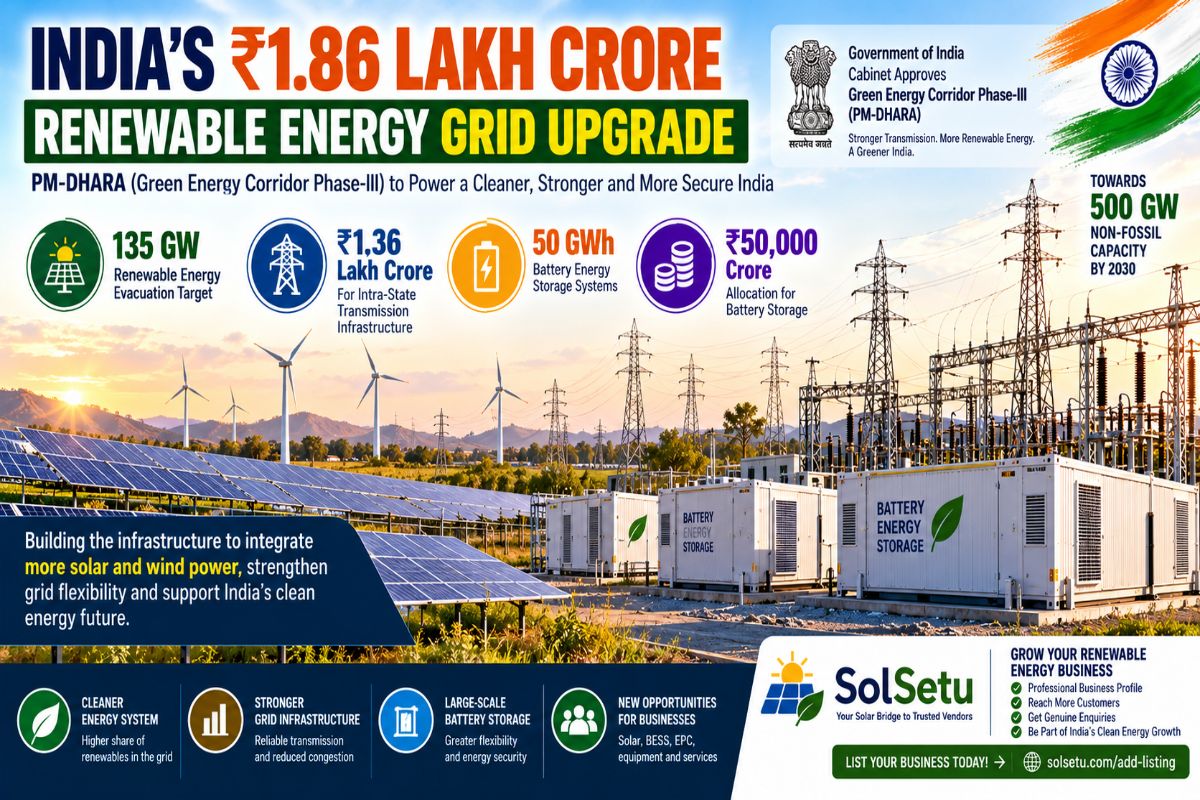
India has approved a major renewable-energy infrastructure programme worth ₹1,86,405 crore to strengthen electricity transmission networks and deploy large-scale battery energy storage systems. The initiative aims to facilitate the evacuation of up to 135 GW of renewable electricity across Indian states and Union Territories.
The Union Cabinet approved the Green Energy Corridor Phase-III (GEC-III) scheme on 30 September 2026. The programme has also been reported under the name PM-DHARA, short for PM-Developing Harmonized and Accelerated Renewable-energy Access.
The programme addresses a major challenge facing India's energy transition: building the transmission and storage infrastructure needed to deliver growing volumes of solar and wind power to electricity consumers.
According to the official government announcement, the programme includes ₹1,36,378 crore for intra-state transmission infrastructure and ₹50,000 crore for 50 GWh of battery energy storage systems.
☀️ Renewable Energy Businesses: Explore New Opportunities
Are you a solar EPC contractor, renewable-energy installer, battery-storage company, equipment supplier or project developer?
Build your business visibility and showcase your services to customers searching for renewable-energy solutions.
What Is the PM-DHARA Scheme?
PM-DHARA is the name used in recent reporting for India's major renewable-energy transmission and storage initiative. The official Cabinet announcement identifies the approved programme as Green Energy Corridor Phase-III (GEC-III).
The scheme is designed to strengthen the intra-state transmission system, improve the movement of renewable electricity and support grid flexibility through battery energy storage.
As India expands solar and wind generation, electricity networks must also expand to transport power from generating locations to demand centres.
Without sufficient transmission capacity and storage, renewable electricity can face congestion, curtailment and difficulty serving demand outside peak solar-generation hours.
Key Highlights of the ₹1.86 Lakh Crore Programme
| Programme Detail | Official Figure |
|---|---|
| Total project outlay | ₹1,86,405 crore |
| Intra-state transmission infrastructure | ₹1,36,378 crore |
| Battery energy storage investment allocation | ₹50,000 crore |
| Planned battery storage capacity | 50 GWh |
| Renewable-energy evacuation target | Up to 135 GW |
| Central financial support | ₹54,082 crore |
| Target implementation period | By FY 2032–33 |
These figures are based on the Government of India's announcement of the approved Green Energy Corridor Phase-III scheme.
Why Does India Need More Renewable Energy Transmission?
India is expanding solar and wind energy capacity to improve energy security, reduce dependence on fossil fuels and support its long-term climate and development objectives.
However, generating renewable electricity is only one part of the process. Electricity must also be transmitted safely and efficiently through a reliable power network.
Several renewable-rich regions are located far from major electricity-demand centres. Stronger intra-state transmission networks can help move electricity from generating projects to distribution networks and consumers.
Improved transmission infrastructure can also reduce network congestion and help electricity systems accommodate greater amounts of variable renewable generation.
₹1.36 Lakh Crore for Transmission Infrastructure
The scheme allocates ₹1,36,378 crore for developing and strengthening intra-state transmission systems.
The investment is intended to help states and Union Territories prepare their electricity networks for larger renewable-energy capacity.
Transmission infrastructure can include:
- High-voltage transmission lines
- Electrical substations
- Power transformers
- Grid interconnections
- Protection and control systems
- Grid monitoring and automation
- Network upgrades and capacity expansion
These infrastructure investments are essential for integrating renewable electricity into India's wider power system.
50 GWh of Battery Energy Storage Systems
Another major element is the deployment of 50 GWh of battery energy storage systems (BESS), supported by a ₹50,000 crore allocation.
Battery storage can store electricity when generation is available and release it when the power system needs it.
For example, solar generation is generally strongest during daylight hours, while electricity demand may remain high in the evening. Batteries can help shift some electricity supply from periods of high generation to periods of greater demand.
Battery energy storage can also support:
- Grid flexibility
- Peak-demand management
- Reduced renewable-energy curtailment
- Management of transmission congestion
- Electricity supply during non-solar hours
- Better integration of solar and wind power
The effectiveness of storage depends on factors such as battery power rating, energy capacity, charging opportunities, discharge duration, operating strategy and project economics.
What Does 50 GWh of Battery Storage Mean?
It is important to distinguish between gigawatts and gigawatt-hours.
Gigawatts (GW) measure power capacity, while gigawatt-hours (GWh) measure the amount of energy that can be stored or delivered over time.
The planned 50 GWh of storage represents energy capacity, not 50 GW of battery power capacity.
For example, a hypothetical battery system with 1 GW of power capacity and 4 GWh of usable energy could deliver 1 GW for approximately four hours under suitable operating conditions.
The actual duration of the storage capacity deployed under the scheme will depend on the power ratings and configurations of the selected projects.
How the Scheme Could Benefit Solar Power Projects
Large solar installations generate electricity during daylight hours, but their output changes with weather conditions and the position of the sun.
When transmission capacity is insufficient, electricity generated by renewable projects may not always be delivered when and where it is needed.
Improved transmission and storage can help address these challenges by strengthening grid connectivity and providing additional flexibility.
Potential benefits include:
- Better integration of utility-scale solar farms
- Improved transmission of renewable electricity
- More opportunities for battery-integrated solar projects
- Reduced risk of certain forms of renewable-energy curtailment
- Better management of peak electricity demand
- More flexible power-system operation
These outcomes will depend on project execution, grid planning, storage deployment and the operating conditions of individual states.
Opportunities for Battery Storage Companies
The planned storage deployment could create opportunities across the battery energy storage supply chain.
Potentially relevant businesses include:
- Battery cell manufacturers
- Battery pack manufacturers
- Battery energy storage system integrators
- Power conversion system suppliers
- Battery management system providers
- Energy management software companies
- Electrical engineering contractors
- Grid automation specialists
- Battery operations and maintenance providers
- Renewable-energy project developers
Companies seeking to participate must monitor the relevant procurement notices, tender conditions, technical specifications and qualification requirements.
What Could This Mean for Solar EPC Companies?
The programme may also be relevant to solar EPC contractors and renewable-energy engineering companies, particularly those working in utility-scale solar, grid integration, electrical infrastructure and hybrid renewable-energy projects.
Potential areas of business activity include:
- Solar power project engineering
- Electrical balance-of-system work
- Grid connectivity infrastructure
- Solar-plus-storage integration
- Electrical substations
- Project commissioning
- Monitoring and control systems
- Operations and maintenance
However, the programme does not automatically provide direct financial assistance to every solar vendor or EPC contractor. Participation depends on the applicable project structure, procurement process and eligibility criteria.
How Will the Scheme Be Implemented?
State Transmission Utilities will serve as the overall implementing agencies for the intra-state transmission component.
According to the government announcement, greenfield transmission projects will be implemented through Tariff-Based Competitive Bidding (TBCB). Brownfield upgrades and network-strengthening works will be executed on a Cost Plus Basis.
Transmission Service Providers may participate in projects under a Build-Own-Operate-Maintain model, depending on the applicable procurement structure.
Businesses interested in these opportunities should follow official tender publications and announcements issued by the relevant state authorities and implementing agencies.
₹54,082 Crore in Central Financial Support
The approved scheme includes ₹54,082 crore in Central Financial Support.
The government says this support will help offset intra-state transmission charges and keep power costs lower for end users.
The assistance is structured around the programme's infrastructure objectives. It should not be interpreted as a universal subsidy available directly to every renewable-energy company or individual solar installation.
Challenges That Must Be Addressed
Large-scale transmission and storage expansion can strengthen India's renewable-energy ecosystem, but several implementation challenges remain.
1. Project Execution
Transmission projects require planning, engineering, procurement, construction and coordination among multiple agencies. Delays in any of these areas can affect commissioning schedules.
2. Land and Right-of-Way
Transmission lines and substations require suitable sites, land access and clearances. These processes can influence project timelines.
3. Battery Storage Economics
Battery projects depend on capital costs, efficiency, operating life, degradation, charging costs and the revenue available from storage services.
4. Grid Coordination
Storage systems and renewable-energy generators must be coordinated with transmission and distribution networks to provide reliable system benefits.
5. Domestic Manufacturing and Supply Chains
India's ability to develop reliable equipment supply chains, technical expertise and service capabilities will be important for long-term deployment.
India's Wider Renewable-Energy Ambition
The transmission and storage programme supports India's broader transition toward a power system with a larger share of non-fossil electricity capacity.
India has set a target of achieving 500 GW of non-fossil electricity capacity by 2030. Reaching that objective requires coordinated development of generation, transmission, distribution and storage infrastructure.
The GEC-III programme is designed to address the transmission and storage side of this transition, complementing investments in renewable-energy generation.
What Should Renewable-Energy Businesses Do Now?
Solar, wind, battery-storage and electrical-infrastructure businesses can take practical steps to prepare for potential opportunities.
- Monitor official government announcements and state transmission tenders.
- Review the technical requirements for grid-connected renewable-energy projects.
- Develop capabilities in battery storage and solar-plus-storage integration.
- Maintain updated company credentials and project references.
- Track procurement notices from state transmission utilities and authorised agencies.
- Build relationships with qualified EPC contractors, equipment suppliers and project developers.
- Maintain a professional online business profile to improve discoverability.
These steps can help companies prepare for the wider market created by India's renewable-energy infrastructure expansion.
Promote Your Renewable-Energy Business on SolSetu
As India's solar, wind and battery-storage sectors expand, customers and project developers need ways to discover relevant renewable-energy suppliers and service providers.
SolSetu — Your Solar Bridge to Trusted Vendors helps renewable-energy businesses build their online presence and showcase their capabilities.
- Professional business profile
- Showcase products and completed projects
- Improve business visibility on search engines
- Receive relevant customer enquiries
- WhatsApp and email lead alerts
- Verified Vendor Badge, subject to applicable requirements
- Priority Search Placement, subject to plan terms
Listing availability, lead delivery and promotional benefits are subject to the applicable SolSetu plan terms.
Plans start from ₹999 for 30 days.
👉 Add Your Renewable-Energy Business on SolSetu
Conclusion
India's ₹1,86,405 crore Green Energy Corridor Phase-III programme represents a major investment in the infrastructure required to support the country's renewable-energy expansion.
With ₹1,36,378 crore allocated for intra-state transmission systems and ₹50,000 crore for 50 GWh of battery energy storage, the scheme aims to facilitate the evacuation of up to 135 GW of renewable electricity.
The programme could create opportunities across transmission infrastructure, battery storage, electrical engineering, renewable-energy integration and project development.
For solar and clean-energy businesses, the important next step is to track official procurement notices, understand the relevant technical requirements and prepare for opportunities as projects are implemented.
India's renewable-energy transition will require not only more solar panels and wind turbines, but also the transmission networks and storage systems needed to deliver clean electricity reliably.
Grow Your Renewable-Energy Business with SolSetu
Showcase your business, improve your visibility and connect with customers looking for solar and renewable-energy solutions.




Leave a Reply