Australia Backs Renewable Electricity to Make Lower-Emission Iron
Australia is moving beyond exporting iron ore and exploring how its abundant renewable-energy resources can be used to manufacture lower-emissions iron at home.
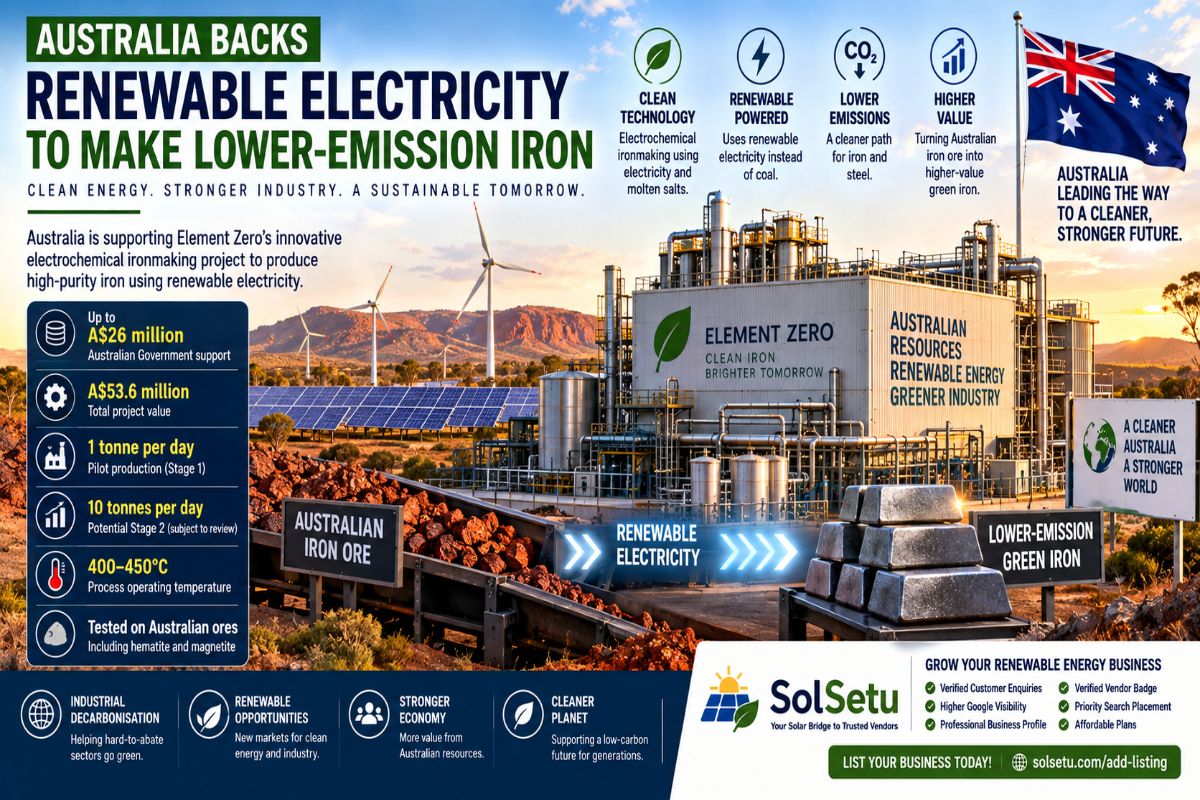
In a major development announced in September 2026, the Australian Government is providing up to A$26 million through the Future Made in Australia Innovation Fund to support Perth-based Element Zero in testing an electrochemical process that could convert Australian iron ore into high-purity iron using renewable electricity.
The project has a total value of approximately A$53.6 million and is aimed at demonstrating an alternative to conventional coal-dependent ironmaking.
Why Green Iron Is Becoming Important
Iron is the foundation of modern steel production, but conventional ironmaking is highly emissions-intensive because traditional processes use coal and other carbon-based materials to remove oxygen from iron ore and provide the required heat and chemistry.
As global industries work to reduce emissions from construction, automobiles, infrastructure and manufacturing, demand is growing for ways to produce iron and steel with substantially lower carbon intensity.
Australia has a unique combination of resources for this transition:
- Large-scale iron ore resources
- Some of the world's strongest renewable-energy potential
- Established mining and export infrastructure
- Engineering and technical expertise
- Existing relationships with major global steelmakers
This creates an opportunity to move further up the value chain by producing processed, lower-emissions iron rather than exporting only raw ore.
Element Zero’s Electrochemical Ironmaking Project
The Australian Government says Element Zero's project will test an alternative form of electrochemical ironmaking. The process uses electricity and molten salts rather than relying on conventional coal-based ironmaking.
The technology is designed to operate at approximately 400–450°C, which is significantly below the temperatures typically associated with traditional ironmaking processes.
The objective is to determine whether the process can efficiently produce high-purity iron from different Australian ores while using renewable electricity as the primary energy input.
From Australian Iron Ore to Australian Green Iron
Australia is already one of the world's major iron ore suppliers. However, exporting raw materials captures less value than manufacturing higher-value products domestically.
Green iron could change that equation.
Instead of the conventional model:
Iron ore → export → overseas processing → steel manufacturing
Australia could increasingly pursue:
Australian iron ore → renewable electricity → lower-emissions iron → higher-value exports
If these technologies become commercially competitive, the shift could create new opportunities for Australian manufacturing, engineering, renewable-energy generation and industrial infrastructure.
How Renewable Electricity Can Transform Ironmaking
The basic principle behind renewable-powered industrial production is straightforward: replace fossil-fuel energy and carbon-intensive processing steps with electricity generated from low-emissions sources.
In an electrochemical process, electricity can directly participate in the chemical reactions required to transform iron ore into iron.
A simplified pathway is:
- Australian iron ore is prepared for processing.
- The ore is introduced into an electrochemical system containing molten salts.
- Electricity drives the chemical reaction that separates oxygen from the iron-bearing material.
- Iron is produced without depending on conventional coal-based reduction.
- Renewable electricity can provide the energy required by the process.
- The resulting iron can potentially become a feedstock for lower-emissions steelmaking.
The actual industrial process is considerably more complex, and the current project is still at the pilot and demonstration stage.
The Pilot Will Start at One Tonne Per Day
The project is planned in two stages.
Stage One will involve a pilot facility designed to produce approximately 1 tonne of iron per day.
Subject to a formal review, Stage Two could scale the demonstration to approximately 10 tonnes per day.
The pilot will also test different Australian iron ores, including hematite and magnetite, helping determine how the technology performs with Australia's diverse ore resources.
Why Western Australia Could Become a Green Iron Hub
Western Australia is particularly important to Australia's green metals strategy because it combines enormous iron ore resources with strong renewable-energy potential and an established mining ecosystem.
The Pilbara region is already a global mining centre. Its next industrial transformation could involve using renewable electricity and new processing technologies to manufacture higher-value products close to the source of the raw material.
This could eventually require significant investment in:
- Large-scale solar farms
- Wind generation
- Transmission infrastructure
- Industrial-scale electricity systems
- Energy storage
- Iron ore processing
- Electric furnaces and electrochemical equipment
- Ports and export infrastructure
Australia’s Wider Green Iron Strategy
Element Zero's project is part of a much broader Australian push into green metals.
The Australian Government has established a A$1 billion Green Iron Investment Fund to support the development of Australia's green iron industry, including early commercial-scale projects.
The government has also identified green metals such as iron, steel, alumina and aluminium as priority industries under its Future Made in Australia agenda.
This policy direction is designed to combine Australia's natural resources with renewable energy and advanced manufacturing capabilities.
Green Iron vs Traditional Ironmaking
| Traditional Ironmaking | Renewable-Powered Green Iron Pathways |
|---|---|
| Heavy dependence on coal and carbon-based inputs | Can use renewable electricity and alternative reduction technologies |
| Very high-temperature processes | Some emerging technologies operate at substantially lower temperatures |
| High emissions intensity | Potentially much lower emissions when powered by clean electricity |
| Established commercial technology | Many emerging pathways remain at pilot or demonstration stage |
| Large global industrial footprint | Potential new clean-manufacturing supply chains |
The Biggest Challenge: Scaling the Technology
The announcement is significant, but it is important to recognise that electrochemical green iron remains an emerging technology. A successful pilot does not automatically guarantee commercial-scale production.
Several challenges must be solved before large facilities can compete with conventional ironmaking.
1. Electricity Cost
Green iron requires substantial amounts of energy. The cost and reliability of renewable electricity will therefore be critical to the economics of future plants.
2. Technology Scale-Up
Moving from a one-tonne-per-day pilot to hundreds of thousands or millions of tonnes per year requires major advances in equipment, materials, process control and industrial integration.
3. Ore Compatibility
Different iron ores have different chemical and physical characteristics. Technologies must demonstrate reliable performance across commercially relevant Australian ore types.
4. Infrastructure
Large green-metal facilities will require new renewable generation, transmission, water, transport and port infrastructure.
5. Global Market Demand
Green iron must ultimately compete in an international market. Buyers will need confidence in product quality, emissions performance, reliability and long-term supply.
Why Renewable Energy Companies Should Watch This Market
Green iron could create an entirely new category of renewable-energy demand.
Instead of renewable electricity being used primarily for homes, offices and conventional industrial loads, future projects could dedicate enormous amounts of clean electricity to industrial heat, chemical processing and metal production.
This could benefit companies involved in:
- Utility-scale solar
- Wind energy
- Battery storage
- High-voltage transmission
- Power electronics
- Industrial automation
- Electrical engineering
- Energy management systems
- Green hydrogen
- Mining electrification
- Industrial water systems
- Clean manufacturing
Could Australia Become a Global Green Metals Exporter?
Australia already has a strong position in global commodity markets. The next opportunity may be to export products with more processing and significantly lower emissions.
If renewable-powered ironmaking becomes commercially viable, Australia could potentially develop a new export category: low-emissions iron and steel feedstocks produced using Australian resources and renewable energy.
That would represent a major shift from Australia's traditional resources model and could strengthen the country's position in global clean-manufacturing supply chains.
The Bigger Renewable Energy Story
The green iron opportunity illustrates a broader change taking place across the global energy system.
Renewable electricity is increasingly moving beyond the traditional power sector and into industries that historically depended on fossil fuels for heat and chemical processes.
Steel, aluminium, chemicals, mining and other heavy industries could become major consumers of renewable electricity as electrification technologies mature.
For Australia, green iron could therefore become one of the most important links between its enormous renewable-energy potential and its resource-rich industrial economy.
Conclusion
Australia's support for Element Zero's electrochemical ironmaking project marks another step toward combining the country's iron ore resources with renewable electricity.
The A$53.6 million project, backed by up to A$26 million in government funding, will test whether Australian iron ore can be converted into high-purity iron through an electricity-based process using molten salts.
The technology still needs to prove its performance and economics at larger scale. But if the pathway succeeds, it could help Australia move from being primarily an exporter of iron ore toward becoming a major producer of lower-emissions iron and green metals.
For the renewable-energy industry, the message is clear: the next major source of clean-energy demand may not only be electric vehicles and buildings. It could also come from the factories producing the world's steel.
Grow Your Solar & Renewable Energy Business with SolSetu
Are you a solar EPC company, renewable-energy installer, distributor or clean-energy technology provider looking for more visibility and qualified customer enquiries?
SolSetu — Your Solar Bridge to Trusted Vendors.
- Verified customer enquiries
- Professional business profile
- Higher Google visibility
- Showcase products, projects and certifications
- WhatsApp & Email lead alerts
- Verified Vendor Badge
- Priority Search Placement
Plans starting from ₹999 / 30 Days.
Leave a Reply