Dubai Scales Up Solar-Powered Desalination for a Water-Secure Future
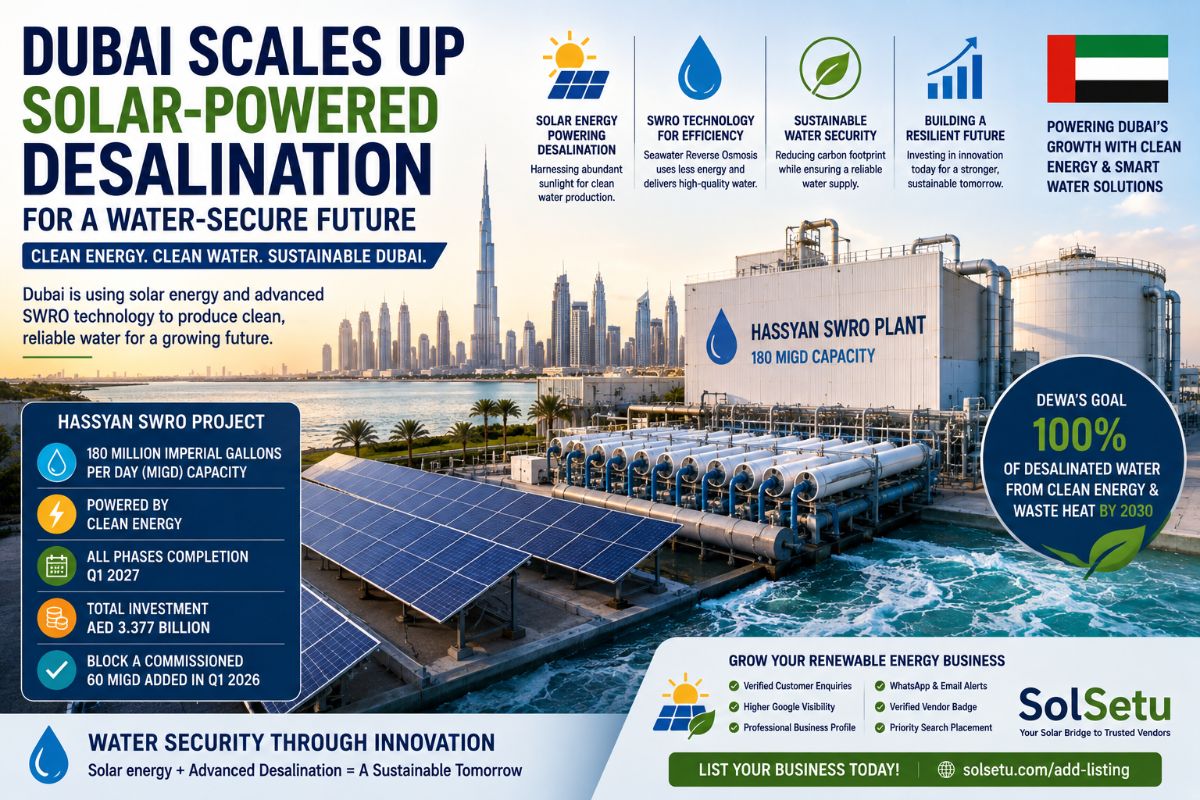
Dubai is taking a major step toward connecting its clean-energy transition with one of its most critical infrastructure needs: water. The emirate is expanding the use of seawater reverse osmosis (SWRO) powered by clean energy, with the Hassyan Seawater Reverse-Osmosis Project emerging as a flagship example of renewable-energy-powered desalination.
Developed by Dubai Electricity and Water Authority (DEWA), the Hassyan project is designed to reach 180 million imperial gallons per day (MIGD) of desalination capacity. DEWA says all phases are scheduled for completion in the first quarter of 2027, with total investment of approximately AED 3.377 billion.
Why Solar-Powered Desalination Matters for Dubai
Dubai has limited natural freshwater resources and therefore relies heavily on desalination to meet demand from households, businesses, tourism, industry and urban development.
Traditional thermal desalination technologies can require substantial amounts of energy. Reverse osmosis offers another approach: instead of boiling seawater, high-pressure pumps push seawater through specialised membranes that separate freshwater from salts and other dissolved substances.
DEWA states that RO technology requires less energy than multi-stage flash distillation, making it an important part of Dubai's strategy to modernise its water-production infrastructure.
Hassyan SWRO: A Major Renewable-Energy and Water Project
The Hassyan Seawater Reverse-Osmosis Project is located at the Hassyan Complex and is being implemented under the Independent Water Producer (IWP) model.
- Planned capacity: 180 MIGD
- Technology: Seawater Reverse Osmosis (SWRO)
- Energy approach: Clean-energy powered
- Investment: Approximately AED 3.377 billion
- Target completion: Q1 2027
- Developer model: Independent Water Producer
DEWA describes Hassyan as one of the world's largest seawater RO projects powered by renewable energy and its first project implemented using the IWP model.
60 MIGD Already Added in 2026
The project is already contributing to Dubai's water infrastructure. In the first quarter of 2026, DEWA commissioned Block A of the Hassyan SWRO plant, adding 60 MIGD of water-production capacity.
DEWA also reported that it expected to add another 120 MIGD of SWRO capacity during 2026. This demonstrates how quickly reverse osmosis is becoming an important component of Dubai's water-production strategy.
How Solar-Powered Reverse Osmosis Works
A renewable-energy-powered desalination system combines electricity generation with advanced water treatment. A simplified process looks like this:
- Seawater is collected from the surrounding marine environment.
- Pre-treatment removes suspended particles and protects the RO membranes.
- High-pressure pumps force the treated seawater through RO membranes.
- Freshwater passes through the membranes while concentrated brine is separated.
- The desalinated water is further treated and integrated into the potable-water network.
- Solar and other clean-energy resources can supply the electricity required by the process.
The combination is particularly attractive in regions such as the UAE, where strong solar resources coincide with high water demand.
Dubai's Bigger 2030 Water Strategy
Hassyan is part of a broader transformation of Dubai's water system. DEWA has stated that its goal is to produce 100% of Dubai's desalinated water using a mix of clean energy and waste heat by 2030.
The strategy represents a shift away from treating electricity and water as completely separate infrastructure systems. Instead, Dubai is increasingly integrating renewable electricity, efficient desalination, thermal energy and water management into a single infrastructure strategy.
The Renewable Energy–Water Nexus
The UAE's solar expansion creates an important opportunity for desalination. Solar power can provide electricity for energy-intensive pumping and membrane systems, while advanced controls and energy-recovery technologies can improve overall efficiency.
This creates a powerful connection between two infrastructure priorities:
- Increasing renewable-energy generation
- Reducing the energy intensity of water production
- Improving long-term water security
- Reducing dependence on conventional energy-intensive desalination
- Building scalable infrastructure for future urban growth
Economic Opportunities for the Clean-Energy Industry
The growth of renewable-energy-powered desalination creates opportunities beyond the construction of large desalination plants.
Companies operating in solar EPC, water treatment, industrial automation, pumps, membranes, energy storage, power electronics, monitoring systems and water-quality management can potentially participate in this expanding market.
The UAE model may also become relevant to other water-stressed regions in the Middle East, North Africa, South Asia and other parts of the world where abundant solar resources coincide with freshwater constraints.
Challenges Still Need to Be Managed
Renewable-energy desalination is promising, but it is not without challenges.
1. Energy Demand
Reverse osmosis is more energy-efficient than many thermal desalination approaches, but it still requires substantial electricity at large scale.
2. Brine Management
Desalination produces concentrated brine that must be managed carefully. Responsible discharge and marine-environment monitoring are important components of sustainable desalination.
3. Marine Impacts
Large desalination facilities require seawater intake and discharge infrastructure. Environmental monitoring and appropriate engineering are therefore essential.
4. Capital Investment
Large SWRO facilities require significant upfront investment in membranes, pumps, intake systems, pipelines, power infrastructure and water-treatment equipment.
Why Dubai's Model Could Matter Globally
Dubai's approach demonstrates how renewable energy can be integrated directly into critical infrastructure rather than being treated only as a source of grid electricity.
For countries facing both water scarcity and rising renewable-energy potential, the combination of solar power + reverse osmosis + energy efficiency + advanced water management could become an increasingly important infrastructure model.
The Hassyan project is therefore more than a desalination plant. It represents a growing convergence between the energy transition and the global water-security challenge.
Conclusion
Dubai is positioning renewable-energy-powered desalination as an important part of its long-term water-security strategy. With the Hassyan SWRO project targeting 180 MIGD and full completion scheduled for Q1 2027, the emirate is demonstrating how large-scale water infrastructure can be redesigned around cleaner and more efficient technologies.
As solar generation continues to expand across the UAE, the energy-water nexus could become one of the most important clean-technology opportunities in the region.
For renewable-energy companies, EPC contractors, technology providers and water-infrastructure specialists, this trend opens a growing market at the intersection of solar power, desalination and sustainable infrastructure.
Grow Your Solar Business with SolSetu
Are you a solar EPC company, installer, distributor or renewable-energy professional looking for more visibility and customer enquiries?
SolSetu — Your Solar Bridge to Trusted Vendors.
- Verified customer enquiries
- Professional business profile
- Higher Google visibility
- Showcase products, projects and certifications
- WhatsApp & Email lead alerts
- Verified Vendor Badge
- Priority Search Placement
Plans starting from ₹999 / 30 Days.





Leave a Reply