Solid-State Batteries: The Future of Safer and Longer-Lasting Energy Storage
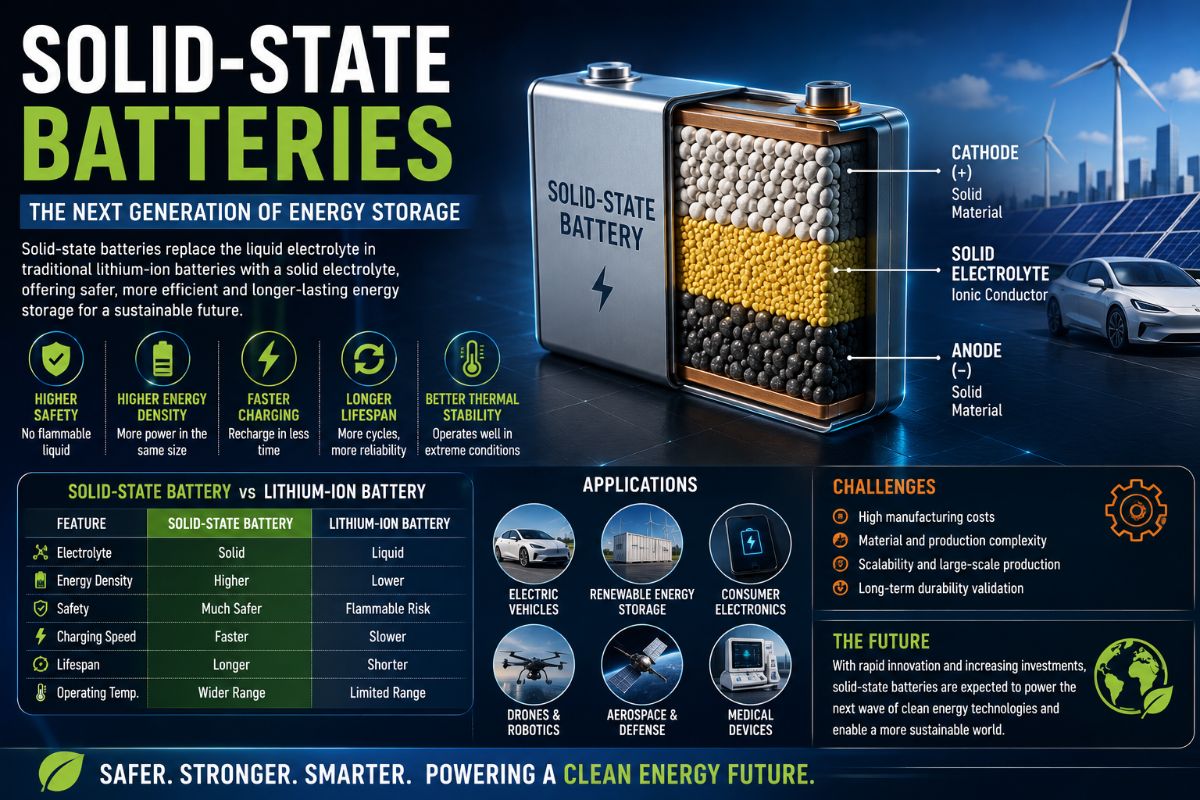
Solid-state batteries are widely regarded as one of the most promising advances in battery technology. By replacing the liquid electrolyte used in conventional lithium-ion batteries with a solid electrolyte, these batteries have the potential to deliver greater safety, higher energy density, faster charging, and longer operational life.
As the demand for electric vehicles (EVs), renewable energy storage, and portable electronics continues to rise, solid-state batteries could become a key technology supporting the global transition to clean energy.
📌 Key Takeaways
- Technology: Solid-State Batteries
- Sector: Energy Storage
- Primary Benefit: Higher energy density with improved safety.
- Applications: Electric vehicles, renewable energy storage, drones, aerospace, smartphones, laptops, and medical devices.
💡 Did You Know?
Solid-state batteries eliminate the flammable liquid electrolyte used in many conventional lithium-ion batteries, reducing fire risk while enabling more compact and energy-dense battery designs.
What Are Solid-State Batteries?
Solid-state batteries are rechargeable batteries that use a solid electrolyte instead of a liquid or gel electrolyte. This design improves thermal stability and enables the use of advanced electrode materials that can increase battery capacity and performance.
How Solid-State Batteries Work
- Electricity is stored through chemical reactions between the anode and cathode.
- Lithium ions move through the solid electrolyte during charging and discharging.
- The solid electrolyte safely conducts ions while preventing leakage.
- The battery delivers stored electrical energy to power connected devices.
- Charging reverses the ion flow, restoring stored energy.
Advantages Over Conventional Lithium-Ion Batteries
- Higher energy density.
- Improved safety with lower fire risk.
- Potential for faster charging.
- Longer battery lifespan.
- Better performance across a wider temperature range.
- Reduced maintenance requirements.
Applications
- Electric vehicles.
- Grid-scale renewable energy storage.
- Consumer electronics.
- Medical equipment.
- Aerospace and aviation.
- Robotics and autonomous systems.
Challenges
Although promising, solid-state batteries remain expensive to manufacture at scale. Researchers continue to improve production methods, reduce costs, enhance durability, and solve engineering challenges before mass commercialization.
Future Outlook
Many automotive manufacturers and battery developers are investing heavily in solid-state technology. As production scales and costs decline, these batteries could significantly improve electric vehicle range, charging speed, and renewable energy storage capabilities.
Frequently Asked Questions
What are solid-state batteries?
Solid-state batteries are rechargeable batteries that use a solid electrolyte instead of the liquid electrolyte found in conventional lithium-ion batteries.
Why are solid-state batteries considered safer?
The solid electrolyte is generally less flammable than liquid electrolytes, reducing the risk of leakage and thermal runaway.
Can solid-state batteries charge faster?
Many researchers believe solid-state batteries have the potential for faster charging, although commercial performance will vary by design.
Why are automakers investing in solid-state batteries?
They offer the potential for longer driving range, shorter charging times, improved safety, and greater durability for electric vehicles.
Can solid-state batteries support renewable energy?
Yes. They could improve stationary energy storage systems by offering safer and more efficient battery performance for storing solar and wind power.
When will solid-state batteries become widely available?
Several companies are developing commercial products, but widespread adoption will depend on manufacturing scale, cost reductions, and continued technological progress.
Recommended Renewable Energy Products
WAAREE II 580–585W TOPCon Bifacial Solar Panel
High-efficiency bifacial solar panel for residential, commercial, and utility-scale solar installations.
Luminous NXG 1450e Solar Inverter
Reliable solar inverter designed for efficient renewable energy systems.
Kenbrook Solar MC4 Crimping Tool Kit
Professional installation tool for secure photovoltaic cable connections.
Pure Copper Lightning Arrester
Reliable lightning protection for solar and renewable energy installations.
Related SolSetu Articles
- Transparent Solar Windows: Turning Buildings into Clean Energy Generators
- Vehicle-to-Grid (V2G): How Electric Vehicles Can Power the Future
- Floating Offshore Wind Farms: Powering the Future of Deep-Sea Renewable Energy
- New Zealand Expands Geothermal Energy for Reliable Clean Power
Affiliate Disclosure: This article contains affiliate links. SolSetu may earn a commission from qualifying purchases at no additional cost to buyers.




Leave a Reply