UK Advances Tidal Stream Energy to Harness Predictable Renewable Power
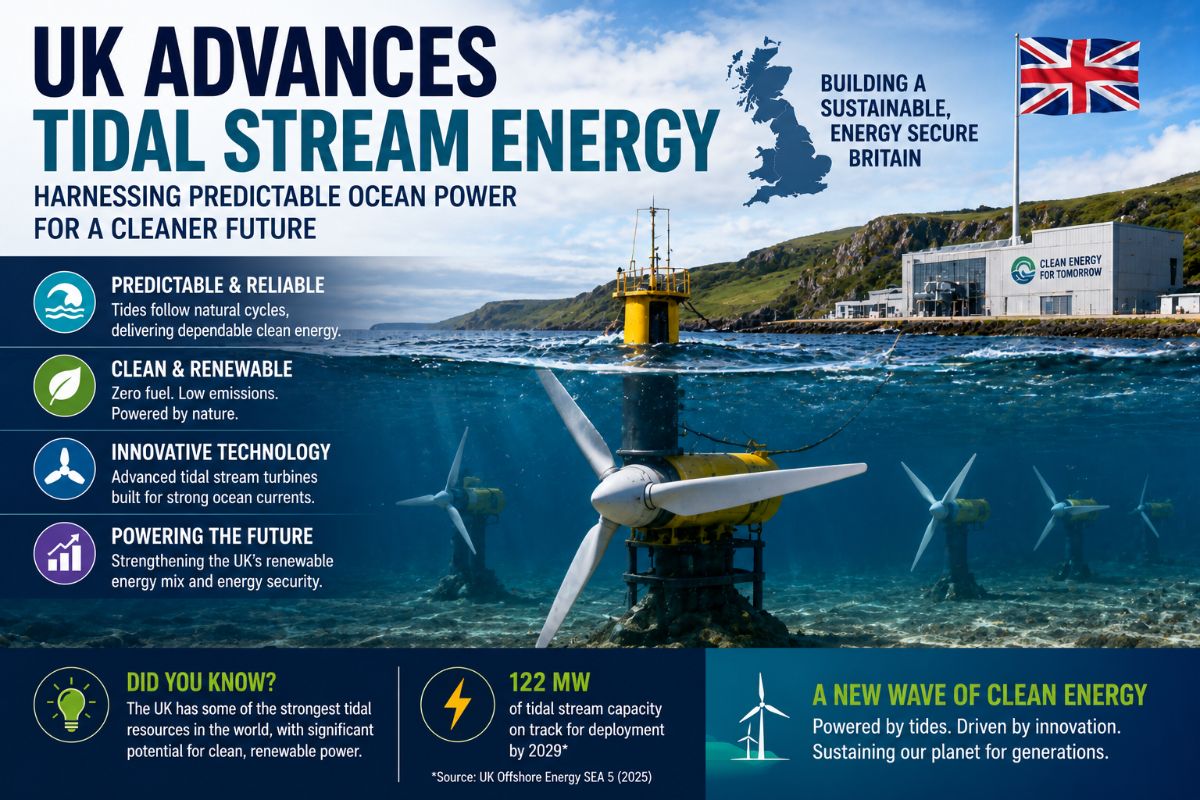
The United Kingdom is advancing tidal stream energy as an emerging source of predictable renewable electricity. Underwater turbines placed in fast-moving tidal currents can generate power from the natural movement of seawater, offering a complementary source of clean electricity alongside wind and solar.
Tidal stream technology remains in the early stages of commercial development in UK waters, but government support is helping projects move toward larger-scale deployment. The UK government's latest Offshore Energy SEA 5 assessment says tidal-stream projects supported through recent Contracts for Difference rounds have a combined capacity of approximately 122 MW and are on track for deployment by 2029.
📌 Key Highlights
- Expansion of UK tidal-stream energy projects.
- Predictable electricity generation from ocean currents.
- Government-backed projects moving toward commercial deployment.
- Strong potential in Scottish and Welsh waters.
- Supports diversification of Britain's renewable-energy mix.
What Is Tidal Stream Energy?
Tidal stream energy uses underwater turbines to capture the kinetic energy of moving seawater. As tides flow through channels, straits and around coastal headlands, the water movement turns turbine blades connected to electrical generators.
Unlike solar power, which depends on sunlight, or wind power, which varies with weather conditions, tidal movements follow highly predictable astronomical cycles. This predictability is one of the technology's most attractive characteristics.
How Do Tidal Stream Turbines Work?
- Ocean currents move through an area with strong tidal flow.
- Moving water rotates underwater turbine blades.
- The turbine drives an electrical generator.
- Electricity travels through subsea cables.
- Power is delivered to the electricity grid.
Why Is the UK Developing Tidal Energy?
The UK has extensive coastline and several areas with strong tidal currents. The government has also created a dedicated support mechanism for tidal stream projects through the Contracts for Difference system.
In Allocation Round 6, several tidal-stream projects in Scotland and Wales secured support, including projects associated with MeyGen, Orbital Marine, Magallanes and other developers. The round awarded a total of 28 MW of tidal-stream capacity for the 2027/28 and 2028/29 delivery years.
Advantages of Tidal Stream Energy
- Highly predictable renewable electricity.
- Low operational carbon emissions.
- Can complement variable solar and wind generation.
- Uses renewable ocean resources.
- Creates opportunities for marine engineering.
- Supports coastal and island economies.
- Can contribute to long-term energy security.
Challenges Facing Tidal Stream Technology
Tidal stream projects face significant engineering and economic challenges. Equipment must operate in strong currents and harsh marine environments, while installation, maintenance and subsea grid connections can be expensive.
Environmental considerations are also important. The UK government notes that the limited number of commercial-scale deployments means there is still uncertainty about the potential effects of larger tidal-stream arrays on marine ecosystems.
Tidal Energy and the UK's Renewable Energy Mix
Tidal stream energy is not expected to replace established renewable technologies such as offshore wind or solar. Instead, its predictable generation profile could complement variable renewable sources and contribute to a more diverse electricity system.
As technology improves and larger projects are deployed, developers hope to reduce costs, improve turbine performance and establish a commercially competitive tidal-energy industry.
Economic Opportunities
The development of tidal stream energy can create opportunities for marine engineering companies, turbine manufacturers, subsea contractors, electrical-equipment suppliers, cable manufacturers, EPC companies, environmental consultants and renewable-energy investors.
Future Outlook
The UK is positioning tidal stream energy as an emerging component of its renewable-energy portfolio. With government support and projects moving toward larger-scale deployment, the technology could become increasingly important for predictable low-carbon electricity generation during the next decade.
🚀 Grow Your Solar & Renewable Energy Business with SolSetu
Are you a Solar EPC Company, Renewable Energy Developer, Battery Storage Provider, EV Charging Company, Marine Energy Supplier, Manufacturer, Installer, Dealer, Distributor or Renewable Energy Consultant?
Join SolSetu – Your Solar Bridge to Trusted Vendors and increase your online visibility while connecting with customers searching for clean-energy solutions across India.
Benefits of Listing on SolSetu
- ✅ Verified customer enquiries
- ✅ Higher Google visibility
- ✅ Professional business profile
- ✅ Showcase products, projects and certifications
- ✅ WhatsApp & Email lead alerts
- ✅ Verified Vendor Badge
- ✅ Priority Search Placement
- ✅ Plans starting from ₹999 for 30 Days
👉 Register Your Business Today:
SolSetu Add Listing
Frequently Asked Questions (FAQ)
What is tidal stream energy?
Tidal stream energy generates electricity by using underwater turbines to capture the kinetic energy of moving tidal currents.
Why is tidal energy considered predictable?
Tides are driven largely by predictable astronomical cycles, allowing tidal electricity generation to be forecast more accurately than weather-dependent renewable sources.
Where is tidal stream energy being developed in the UK?
Recent UK-supported tidal-stream projects are being developed in Scottish and Welsh waters, including projects associated with the Pentland Firth and other areas with strong tidal resources.
Can tidal energy replace offshore wind?
No. Tidal stream energy is better viewed as a complementary technology. Its predictable generation profile can diversify the renewable-energy mix alongside wind and solar.
What are the main challenges of tidal stream energy?
Major challenges include high installation and maintenance costs, harsh marine conditions, subsea electrical infrastructure and the need to better understand potential environmental impacts at larger deployment scales.
Who can register on SolSetu?
Solar companies, renewable-energy developers, battery-storage providers, EV charging companies, manufacturers, installers, dealers, distributors and renewable-energy consultants can create a business listing on SolSetu.
How can SolSetu help renewable-energy businesses?
SolSetu helps businesses improve online visibility, showcase products and projects, and receive customer enquiries from people searching for renewable-energy solutions.
Related SolSetu Articles
- Finland Advances Seasonal Thermal Energy Storage for Cleaner District Heating
- South Korea Accelerates Vehicle-to-Grid Technology for Smarter Renewable Energy Integration
- Norway Accelerates Floating Offshore Wind Farms for a Sustainable Energy Future
- Iceland Accelerates Green Methanol Production to Support Sustainable Shipping




Leave a Reply