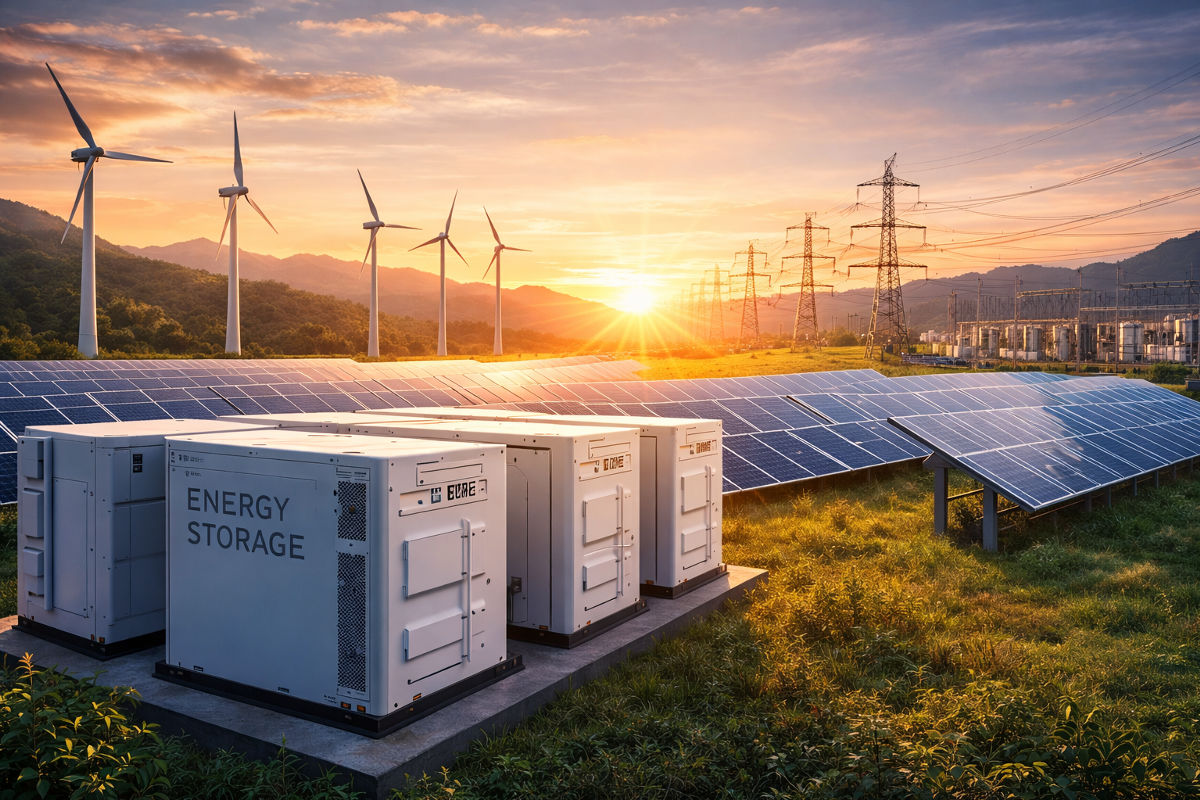
Energy Storage Moves to the Center of India’s Renewable Strategy as Grid Priorities Tighten in 2026
Published: January 23, 2026 | 05:00 PM IST
By: SolSetu Editorial Desk
In 2026, India’s renewable energy expansion is no longer being measured purely by installed capacity. Grid reliability, peak-time availability, and system flexibility have moved to the forefront, placing energy storage at the center of national clean energy strategy.
From Intermittent Supply to Dispatchable Power
Solar and wind continue to dominate new capacity additions, but their integration into the grid is now governed by performance expectations rather than volume alone. Utilities and system operators are increasingly prioritizing projects that can deliver predictable output during peak demand periods.
This shift has accelerated the deployment of battery energy storage systems, transforming renewables from intermittent resources into dispatchable assets.
Policy Signals Reinforce Storage Adoption
India’s policy direction in 2026 reflects a clear recognition of storage as critical infrastructure. Hybrid tenders, peak power obligations, and round-the-clock renewable supply frameworks are pushing developers to integrate storage at the project design stage.
Rather than treating batteries as optional add-ons, new procurement models increasingly embed storage capacity as a core requirement.
Market Economics Begin to Align
Declining battery costs, coupled with improved lifecycle performance, are reshaping project economics. Storage-backed solar projects are now being evaluated on avoided curtailment, time-shifted energy value, and grid support benefits.
For developers and investors, this marks a transition from speculative adoption to financially grounded deployment.
Execution Capability Becomes the Differentiator
As storage scales, execution quality has become a key differentiator. System sizing, thermal management, degradation modeling, and integration with plant-level controls are now decisive factors in long-term performance.
This has elevated the role of experienced EPCs, integrators, and technology providers capable of delivering bankable, grid-compliant solutions.
What 2026 Signals for India’s Clean Energy Trajectory
Energy storage is no longer a future consideration for India’s renewable sector. In 2026, it has become an enabling backbone—supporting higher renewable penetration while maintaining grid stability and power quality.
The next phase of growth will favor projects that align generation, storage, and grid requirements into a single performance-driven system.
Outlook: Performance Over Megawatts
India’s clean energy transition is entering a mature phase where success is defined by reliability rather than record-breaking capacity numbers. Storage-led design, disciplined execution, and measurable outcomes will shape the sector’s trajectory beyond 2026.




Leave a Reply