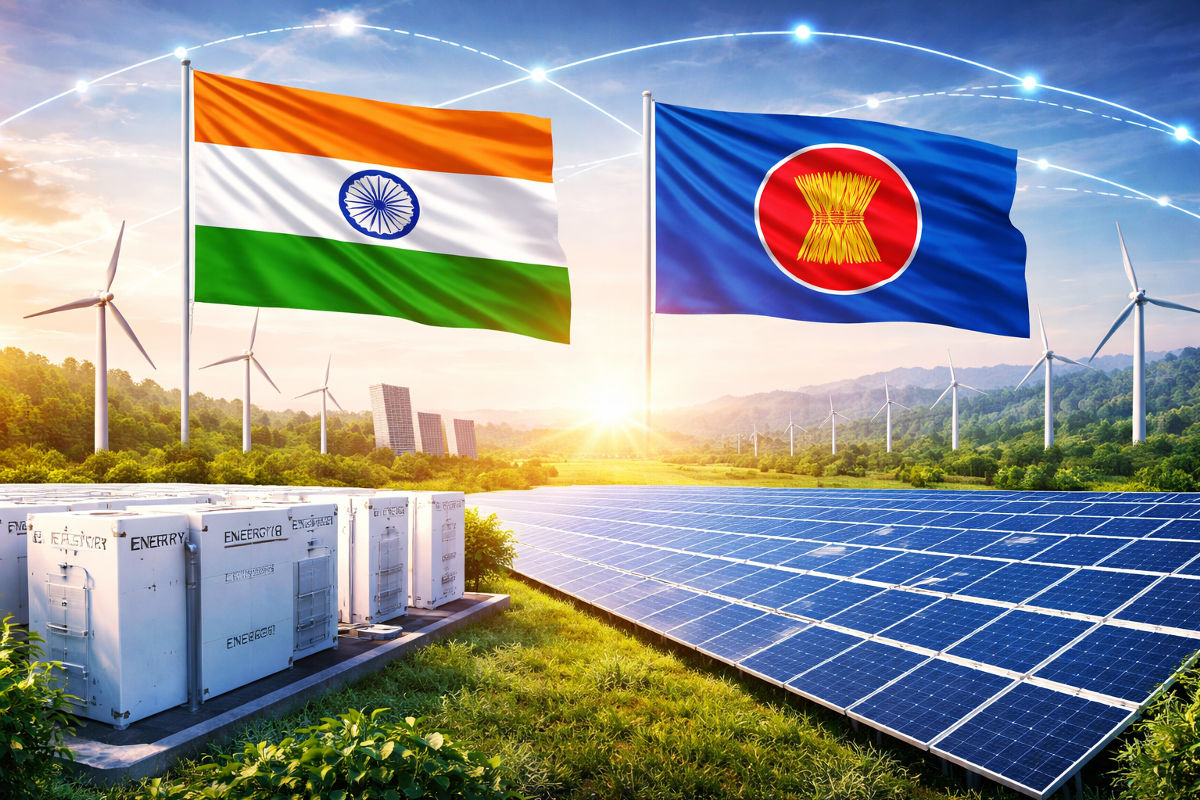
India–ASEAN Clean Energy Corridor Takes Shape as 2026 Marks a Regional Inflection Point
Published: January 23, 2026 | 08:00 AM IST
By: SolSetu Editorial Desk
As 2026 unfolds, India and ASEAN economies are no longer advancing their renewable energy agendas in isolation. A coordinated regional clean energy corridor is beginning to take shape—driven by aligned policy intent, manufacturing scale, capital mobility, and a shared urgency to stabilize power systems while accelerating decarbonization.
Asia’s Renewable Momentum Enters a Coordinated Phase
India’s solar and energy storage ecosystem has moved decisively beyond rapid capacity addition. The sector is now transitioning toward a model defined by operational performance, grid integration, and dispatchable renewable power.
In parallel, ASEAN markets are scaling from pilot initiatives to utility-grade solar, hybrid, and storage-backed deployments—creating a strategic convergence between India’s execution capability and Southeast Asia’s demand for reliable clean energy.
India’s Role Evolves From Capacity Builder to Regional Anchor
India’s clean energy strategy in 2026 reflects a structural shift. Solar deployment is increasingly paired with battery energy storage systems, while project design prioritizes dispatchability, grid stability, and long-term performance assurance.
Expansion in domestic manufacturing—covering modules, inverters, trackers, and storage technologies— positions India as both a large renewable market and a regional execution partner.
ASEAN’s Scaling Phase Demands Precision
Across Southeast Asia, renewable adoption is accelerating with an emphasis on grid compatibility, financial bankability, and reliable EPC execution. Governments and utilities are prioritizing hybrid systems, energy storage integration, and performance-backed project structures.
This environment elevates India–ASEAN collaboration beyond trade into technology transfer, EPC partnerships, and cross-border investment alignment.
Platforms Accelerating Regional Collaboration
Industry platforms and regional clean energy exhibitions are playing a growing role in enabling partnerships. These forums connect developers, manufacturers, EPC firms, financiers, and policymakers, helping convert policy ambition into executable projects.
For Indian clean energy companies, this represents structured market access. For ASEAN stakeholders, it provides exposure to scale-tested solutions refined under demanding operating conditions.
What the Emerging Clean Energy Corridor Signals
The India–ASEAN clean energy corridor is no longer theoretical. In 2026, it is actively forming through EPC collaborations, storage-led solar project structuring, standardized performance benchmarks, and capital flows aligned with execution capability.
Outlook: Purposeful Regional Integration
Clean energy growth in Asia is entering a systems-driven era. Success will depend on coordinated progress across solar generation, storage, grid infrastructure, and capital deployment. 2026 may ultimately be remembered as the year India and ASEAN moved from parallel progress to purposeful clean energy collaboration.








Leave a Reply