
Published: 14 January 2026 | 11:00 AM IST
Category: Asia Solar News
Author: Girish
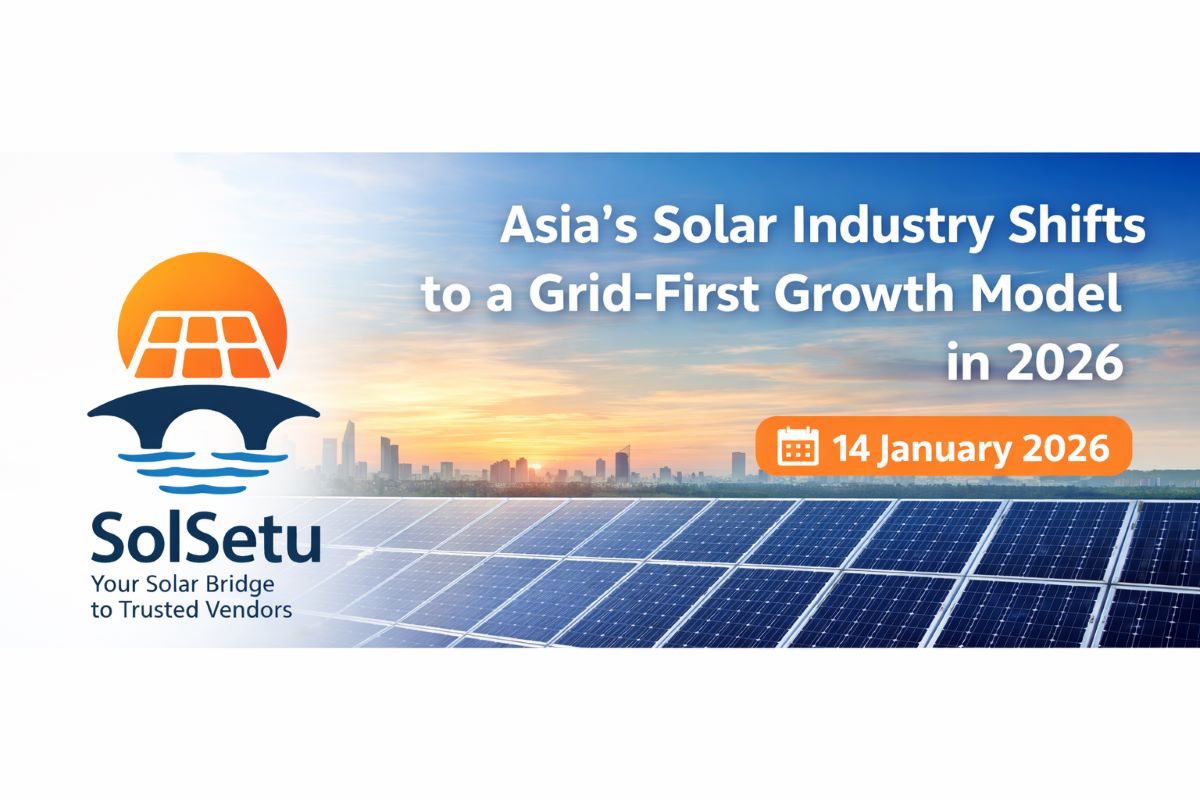
Asia’s Solar Industry Shifts to a Grid-First Growth Model in 2026
Storage integration, AI forecasting, and regional manufacturing redefine solar deployment across Asia
New Delhi / Singapore / Tokyo:
Asia’s solar power sector has entered a decisive new phase in early 2026, transitioning from capacity-driven expansion to a grid-first, intelligence-led growth model. The region’s focus is now firmly on reliability, predictability, and system integration rather than standalone megawatt additions.
Across major Asian markets, policymakers, utilities, and developers are recalibrating strategies to address grid congestion, intermittency, and supply-chain risk—reshaping how solar projects are designed, financed, and operated.
Solar + Storage Becomes the New Baseline
Hybrid solar projects integrating battery energy storage systems (BESS) are rapidly becoming the default tender structure across Asia. Utilities increasingly demand dispatchable solar power, pushing developers to bundle storage capacity to ensure firm supply and minimize curtailment risks.
For commercial and industrial consumers, storage is evolving beyond backup power into a financial optimization tool, enabling tariff arbitrage and peak-demand management.
AI Forecasting Enters Commercial Contracts
A defining trend of 2026 is the contractual adoption of AI-driven solar generation forecasting. Advanced weather analytics and machine-learning models are now being embedded into power purchase agreements to reduce deviation penalties and improve revenue certainty.
This marks a shift from post-commissioning optimization to pre-bid, intelligence-led project design.
Manufacturing Localization Gains Strategic Momentum
Asian governments and private investors are accelerating domestic manufacturing of solar modules, inverters, and balance-of-system components. The objective is clear: reduce exposure to global trade volatility while strengthening regional energy security.
This localization push is fostering a more resilient and competitive solar supply ecosystem across South Asia, Southeast Asia, and East Asia.
Rooftop and Distributed Solar Gain Policy Priority
Urban grid stress and land constraints are driving renewed policy focus on rooftop and distributed solar. Faster interconnection timelines, refined net-billing mechanisms, and digital approval systems are improving project bankability.
This trend is particularly visible in high-density Asian cities, where rooftop solar is now viewed as critical urban energy infrastructure.
Outlook
By 2026, Asia’s solar success is no longer measured by installed capacity alone. Bankability, grid integration, and data-driven performance now define leadership in the region’s clean-energy transition.
About SolSetu
SolSetu is a solar-focused digital media and industry engagement platform connecting verified vendors, developers, manufacturers, policymakers, and clean-energy stakeholders across Asia. SolSetu delivers trusted solar news, market intelligence, and partnership opportunities for the renewable energy ecosystem.
Website: https://solsetu.com
Advertising & Partnerships:
Advertise with us



Leave a Reply