India’s Offshore Wind Energy Industry: ₹7,453 Crore Support Programme Opens New Opportunities
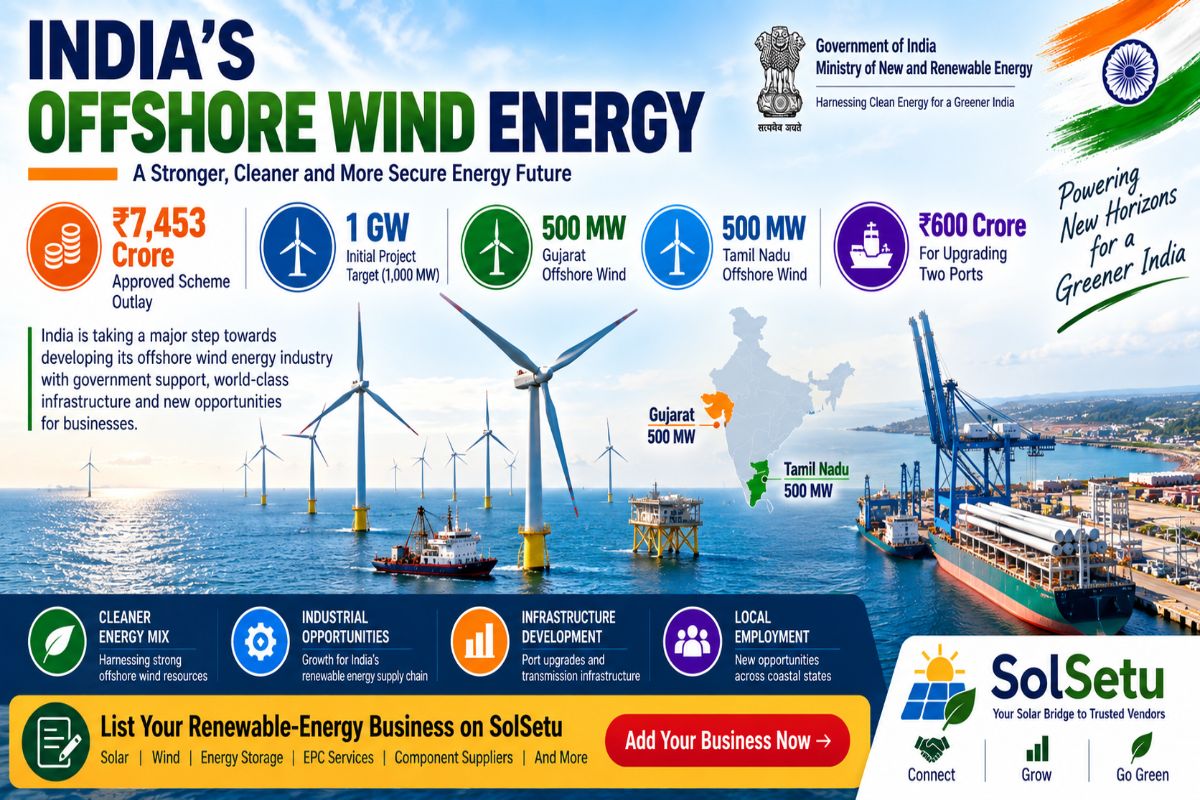
India is working to establish an offshore wind energy industry, with a government-approved support programme worth ₹7,453 crore aimed at helping develop its first 1 GW of offshore wind projects. The programme targets 500 MW of projects off Gujarat and another 500 MW off Tamil Nadu, alongside financial support for upgrading two ports to handle offshore wind equipment and logistics.
Offshore wind could become an important part of India's long-term renewable-energy mix. Unlike conventional onshore wind farms, offshore projects place turbines in marine environments, where wind resources, foundations, installation methods, maintenance requirements and grid connections require specialised engineering.
For Indian companies, the emerging sector could create opportunities in marine construction, electrical infrastructure, turbine components, port logistics, surveying, offshore substations and long-term operations and maintenance.
Official programme source: Press Information Bureau — Offshore Wind Viability Gap Funding Scheme.
Are You a Renewable-Energy Business?
Showcase your engineering services, products, project experience and renewable-energy capabilities to potential customers.
What Is India's Offshore Wind Programme?
The Union Cabinet approved a Viability Gap Funding (VGF) scheme for offshore wind energy projects on 19 June 2024, with a total outlay of ₹7,453 crore.
The programme includes ₹6,853 crore to support the installation and commissioning of 1 GW of offshore wind capacity, comprising 500 MW off Gujarat and 500 MW off Tamil Nadu. Another ₹600 crore was allocated for upgrading two ports to meet offshore wind logistics requirements.
Viability Gap Funding is intended to help reduce project costs and improve commercial viability. It does not mean that every wind-energy company or proposed project automatically qualifies for funding.
Key Facts: India's Offshore Wind Scheme
| Parameter | Government Programme Detail |
|---|---|
| Total approved VGF scheme outlay | ₹7,453 crore |
| Support for offshore wind projects | ₹6,853 crore |
| Port infrastructure support | ₹600 crore |
| Initial project capacity covered | 1,000 MW (1 GW) |
| Gujarat project allocation | 500 MW |
| Tamil Nadu project allocation | 500 MW |
| Nodal ministry | Ministry of New and Renewable Energy (MNRE) |
| Offshore power evacuation infrastructure | Power Grid Corporation of India Ltd. is assigned a role in developing the relevant evacuation infrastructure under the programme |
These are approved programme details. They should not be interpreted as confirmation that all 1 GW has already been constructed or commissioned.
Why Is India Exploring Offshore Wind Power?
India has a coastline of approximately 7,600 kilometres and substantial offshore wind resources in selected marine areas. The government has focused its initial project-development efforts on Gujarat and Tamil Nadu.
Offshore wind can complement solar power and onshore wind because its generation profile may differ by location and time. In suitable conditions, offshore projects can deliver high annual electricity generation, but actual output depends on wind conditions, turbine availability, project design and transmission constraints.
Offshore wind may also support coastal industrial demand, including electricity-intensive manufacturing and future green-hydrogen production.
Where Are India's Offshore Wind Opportunities?
1. Gujarat
Gujarat is one of the two priority states identified for India's initial offshore wind development. Its coastline and established industrial and port infrastructure make it a key location for offshore wind assessment and project planning.
Potential business areas include offshore engineering, marine logistics, electrical equipment, foundations, port services and transmission infrastructure.
2. Tamil Nadu
Tamil Nadu is the second priority state under the initial 1 GW VGF-supported programme. Offshore wind development could complement the state's existing renewable-energy ecosystem and coastal industrial demand.
Companies should monitor official seabed leasing, tender, survey and project-development announcements rather than assuming that a particular site is already available for construction.
How Much Offshore Wind Potential Does India Have?
The National Institute of Wind Energy has identified substantial offshore wind potential along India's western and southern coastlines. MNRE's published overview reports preliminary estimates of approximately 36 GW off Gujarat and 35 GW off Tamil Nadu.
These figures are resource-potential estimates, not installed capacity. Developing offshore wind requires detailed wind measurements, seabed studies, environmental assessment, marine spatial planning, project economics and suitable grid connections.
The government's offshore wind strategy has also outlined a longer-term development pathway. Actual capacity additions will depend on project economics, procurement, financing, infrastructure readiness and execution.
Official resource: MNRE Offshore Wind Programme.
What Does Viability Gap Funding Mean for Offshore Wind?
Offshore wind projects can have high initial costs because they require specialised turbines, marine foundations, offshore electrical systems, installation vessels, underwater cables and complex maintenance arrangements.
Viability Gap Funding is a government support mechanism designed to help bridge a project's commercial viability gap under the applicable scheme and bidding framework.
Under the approved programme:
- ₹6,853 crore was allocated for support associated with the initial 1 GW of offshore wind projects.
- ₹600 crore was allocated for upgrading two ports for offshore wind logistics.
- Private developers are expected to be selected through the applicable transparent bidding process.
- Power evacuation infrastructure, including offshore substations under the programme, has a designated role for Power Grid Corporation of India Ltd.
Companies must examine the relevant tender documents, eligibility criteria, payment conditions and risk allocation before committing capital or submitting bids.
Why Are Ports Important for Offshore Wind?
Offshore wind turbines and their components are large and heavy. Their transportation, storage, pre-assembly and loading require specialised port facilities and careful logistics planning.
Port infrastructure may need to accommodate:
- Large turbine blades and tower sections
- Heavy nacelles and electrical equipment
- Foundation fabrication and handling
- Heavy-lift cranes and suitable quayside areas
- Installation-vessel access and marine operations
- Temporary component storage and assembly
The approved programme includes ₹600 crore for upgrading two ports to meet offshore wind logistics requirements. The specific scope and procurement opportunities should be verified through official implementation documents.
Business Opportunities Across the Offshore Wind Supply Chain
Offshore wind requires a broad industrial ecosystem. Companies do not necessarily need to manufacture complete turbines to participate; specialised suppliers and service providers can contribute to individual parts of the project lifecycle.
1. Engineering, Procurement and Construction
Qualified EPC and engineering firms may find opportunities in electrical systems, substations, civil works, cable infrastructure and supporting facilities, depending on tender scope and qualification requirements.
2. Turbine Components and Manufacturing
Potential supply-chain areas include fabricated steel structures, electrical assemblies, power electronics, cables, fasteners and other components that meet the applicable technical and quality standards.
3. Marine Engineering and Surveying
Specialist contractors can provide seabed surveys, geotechnical investigations, hydrographic studies, environmental assessments and marine construction services.
4. Ports and Heavy Logistics
Port operators, heavy-lift service providers, transport companies and equipment-handling specialists may participate in the offshore wind logistics chain.
5. Transmission and Grid Connection
Offshore wind farms require electrical systems to transfer power from turbines through offshore collection networks and substations to the onshore grid.
6. Operations and Maintenance
Once projects are operational, specialist services may include inspections, condition monitoring, electrical maintenance, corrosion management, marine support and spare-parts logistics.
What Has Changed in 2026?
India's offshore wind development has continued to feature in government clean-energy cooperation and implementation discussions.
In 2026, the government highlighted the India–UK Offshore Wind Taskforce as a coordination mechanism for ecosystem planning, market design, port modernisation, domestic supply chains, financing and risk mitigation.
These activities indicate that offshore wind development involves more than allocating funding: it also requires bankable commercial arrangements, a capable domestic supply chain, specialised infrastructure and clear project responsibilities.
However, a taskforce or policy announcement is not the same as a project financial close, construction start or commissioning milestone. Developers and suppliers should verify the latest official tender and project status before relying on a particular opportunity.
Further reading: PIB — India–UK Offshore Wind Taskforce and sector development.
Key Challenges Facing Offshore Wind in India
Project Costs and Financing
Offshore projects require significant capital expenditure and specialised equipment. Stable revenue arrangements and carefully structured project finance are important to reduce uncertainty.
Marine Conditions
Wind, waves, currents, seabed geology and corrosion influence turbine foundations, installation methods and maintenance schedules.
Transmission Infrastructure
Offshore generation requires coordinated development of subsea cables, offshore substations, onshore substations and grid capacity.
Environmental and Maritime Approvals
Projects must account for marine ecosystems, fisheries, navigation, defence requirements and other uses of coastal and offshore areas.
Domestic Supply-Chain Readiness
India will need specialised skills, qualified manufacturers, marine contractors and equipment suppliers capable of meeting project specifications and delivery schedules.
How Can Indian Businesses Prepare?
Companies interested in offshore wind should begin with practical preparation:
- Identify the equipment or service category in which they can compete.
- Develop technical credentials and quality documentation.
- Build partnerships with experienced marine, electrical or wind-energy firms.
- Monitor MNRE, NIWE, SECI, PGCIL and relevant port procurement announcements.
- Assess tender eligibility, project experience requirements and financial qualifications.
- Study applicable environmental, safety and marine-operating standards.
- Track project awards and construction milestones before committing resources.
New entrants should avoid assuming that the approved VGF outlay is directly available to all suppliers. Funding and procurement arrangements depend on the specific scheme and project documents.
Grow Your Renewable-Energy Business with SolSetu
As India's renewable-energy sector expands into new technologies, a professional online profile can help businesses present their products, services and project capabilities to potential customers and partners.
SolSetu — Your Solar Bridge to Trusted Vendors is a renewable-energy business directory and knowledge platform serving the Indian market.
- Showcase your renewable-energy business and services.
- Present products, projects and technical capabilities.
- Improve online business visibility.
- Receive potential customer enquiries through available listing features.
- Use eligible profile and promotion features according to your selected plan.
Business listing plans start from ₹999 for 30 days, subject to the current offer and plan terms.
👉 Add Your Business on SolSetu
Conclusion
India's offshore wind industry is moving through an important development phase. The ₹7,453 crore VGF programme provides an approved support framework for an initial 1 GW of projects off Gujarat and Tamil Nadu, with separate funding for port upgrades.
Turning this framework into operating wind farms will require successful procurement, bankable project economics, suitable marine infrastructure, reliable transmission and an experienced supply chain.
For engineering firms, manufacturers, marine contractors, port service providers and renewable-energy specialists, offshore wind is a sector worth monitoring. The best approach is to track official tenders and verified project milestones while building the technical and commercial capabilities needed to participate.
Build Your Renewable-Energy Network
Showcase your business, products and services to potential customers through SolSetu.
LIST YOUR BUSINESS ON SOLSETU →
SolSetu — Your Solar Bridge to Trusted Vendors.




Leave a Reply