India's Battery Energy Storage Boom: ₹5,400 Crore Support, BESS Tenders and Business Opportunities
India's battery energy storage sector is expanding as the power system needs greater flexibility to integrate solar and wind electricity. Government support programmes, competitive procurement and new standalone storage tenders are creating opportunities for battery integrators, renewable-energy developers, electrical contractors, equipment suppliers and engineering companies.
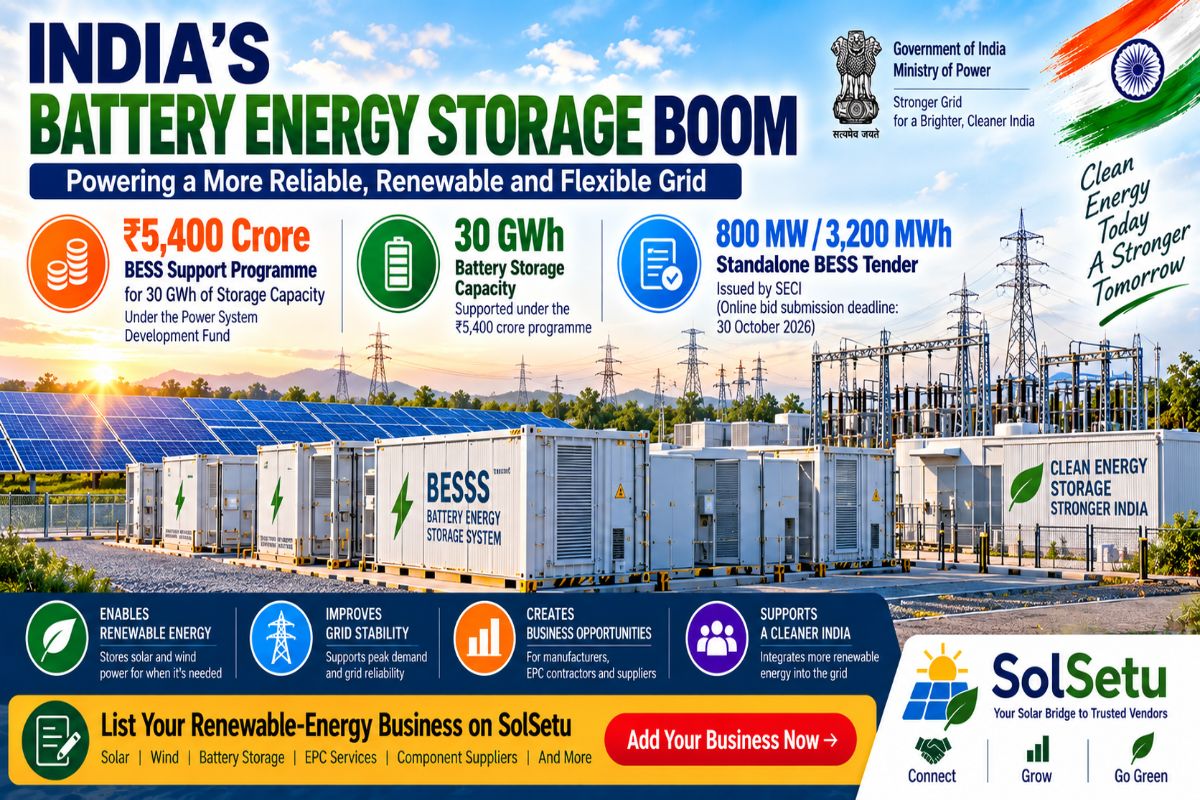
The Ministry of Power has outlined multiple measures to accelerate energy storage. These include a ₹3,760 crore viability-gap funding programme and a separate ₹5,400 crore programme supporting 30 GWh of battery energy storage capacity through the Power System Development Fund.
There is also active procurement. The Solar Energy Corporation of India (SECI) published an 800 MW / 3,200 MWh standalone Battery Energy Storage System (BESS) tender on 1 October 2026. Its listed online bid-submission deadline is 30 October 2026, subject to any subsequent amendments.
For businesses in India's renewable-energy supply chain, this is an important time to understand how BESS projects work, which companies may participate and what technical and commercial requirements matter.
Official sources: Ministry of Power and MNRE energy storage update | SECI 800 MW / 3,200 MWh BESS tender.
Are You a Solar, Battery or Electrical Business?
Showcase your products, technical services, project experience and renewable-energy capabilities on SolSetu.
What Is a Battery Energy Storage System?
A Battery Energy Storage System stores electricity in batteries and releases it when required. A grid-scale BESS generally includes battery modules, a battery management system, power conversion equipment, thermal management, protection systems, controls and monitoring.
Depending on the project design, a BESS can charge from renewable generation or the grid and discharge during periods of higher demand, lower renewable output or when grid services are required.
Battery storage is not an electricity source in the same way as a power plant. It shifts electricity across time and loses some energy during charging and discharging. Its value depends on how it is operated, its efficiency, degradation, availability, connection arrangements and revenue model.
India's Battery Storage Support Programmes
The government has approved multiple measures to support large-scale storage deployment and domestic battery manufacturing.
| Programme or Measure | Published Detail |
|---|---|
| First BESS viability-gap funding programme | ₹3,760 crore approved outlay |
| Capacity under the first programme | Initially approved for 4 GWh; subsequently enhanced to approximately 13.22 GWh in government reporting |
| Additional BESS VGF programme | ₹5,400 crore from the Power System Development Fund |
| Capacity under the additional programme | 30 GWh |
| Domestic Advanced Chemistry Cell manufacturing programme | ₹18,100 crore PLI programme for 50 GWh of manufacturing capacity |
| Grid-scale stationary storage allocation under ACC programme | 10 GWh earmarked |
| Central Electricity Authority estimate for 2029–30 | 60.63 GW of storage power capacity, including 41.65 GW of BESS and 18.98 GW of pumped storage |
These figures refer to different policies and measures. The funding allocations, battery manufacturing programme and estimated future storage requirement should not be added together as if they were one subsidy or one procurement target.
Official source: Government of India: Measures to scale up energy storage.
What Is Viability Gap Funding for BESS?
Viability Gap Funding (VGF) is a form of financial support intended to improve the commercial viability of eligible infrastructure projects.
Battery storage can involve substantial upfront investment. Its commercial returns depend on factors such as charging costs, discharge revenue, contractual availability, efficiency, battery degradation, financing costs and the services it provides to the power system.
VGF can help bridge a project's financial viability gap, subject to the applicable scheme conditions.
Under the separate ₹5,400 crore programme approved in June 2025, the government identified 30 GWh of BESS capacity for support through the Power System Development Fund. Government reporting describes allocations across states and NTPC, with project development and procurement progressing through implementation stages.
Financial support is not an unconditional grant to every battery supplier or installer. Companies must check the scheme's operational guidelines, project allocation, procurement documents and eligibility requirements.
SECI's 800 MW / 3,200 MWh BESS Tender
SECI published a Request for Selection for supply of energy from 800 MW / 3,200 MWh of standalone battery energy storage systems in India under the SECI-ESS-IV procurement.
The tender listing records the following details:
- Procuring agency: Solar Energy Corporation of India Limited (SECI)
- Project capacity: 800 MW / 3,200 MWh
- Configuration: Standalone battery energy storage
- Publication date: 1 October 2026
- Listed online bid-submission deadline: 30 October 2026
- Listed bid-opening date: 4 November 2026
The 800 MW / 3,200 MWh configuration represents four hours of storage at the stated rated power, based on the simple ratio of energy capacity to power capacity. Actual operating requirements, usable energy, auxiliary consumption and contractual discharge obligations must be confirmed in the tender documents.
Companies interested in bidding should immediately check the official tender page for amendments, updated deadlines, pre-bid clarifications and qualification requirements.
View the official SECI BESS tender →
Why Does India Need Battery Storage?
Solar generation varies with daylight and weather. Wind generation also changes with weather conditions. Electricity demand, meanwhile, may peak at times when renewable generation is lower.
Battery storage can help shift electricity from one period to another and provide services that support grid operation.
1. Time-Shifting Solar Electricity
A battery can charge during periods of high solar output and discharge later, depending on charging arrangements and the project's operating strategy.
2. Peak-Demand Management
Storage can deliver electricity during contracted peak periods and help meet demand when other sources are expensive or constrained.
3. Renewable-Energy Integration
Battery storage can help manage fluctuations in renewable output and improve the dispatchability of selected renewable-energy projects.
4. Grid Support
When appropriately designed and contracted, BESS installations can provide services such as frequency response, ramping support and other grid services supported by the equipment and applicable market rules.
5. Transmission and Distribution Support
Storage may help manage local congestion or defer some network investments where the location, operating profile and economics make it suitable. It is not a universal substitute for grid expansion.
Standalone BESS vs Solar-Plus-Storage
| Feature | Standalone BESS | Solar-Plus-Storage |
|---|---|---|
| Charging source | Grid or contracted sources, as permitted | Solar generation and potentially other permitted sources |
| Primary design consideration | Contracted power, energy, availability and services | Coordination between solar generation, battery charging and delivery obligations |
| Site requirements | Land, grid connection and electrical infrastructure | Solar site or connection arrangements plus storage facilities |
| Potential applications | Peak supply, grid services and energy shifting | Shifting solar output, improving delivery profiles and peak supply |
| Main commercial risks | Charging cost, utilisation, degradation and contracted revenue | Solar output, storage operation, degradation and contracted revenue |
The preferred model depends on the project's revenue structure, power-market rules, grid connection, land availability and technical requirements.
Who Can Participate in India's BESS Supply Chain?
Battery storage projects need more than battery cells. They require integrated engineering, electrical systems, software, safety equipment, commissioning and long-term maintenance.
1. Battery Pack and System Integrators
These companies assemble battery modules, racks, enclosures and supporting systems to meet project specifications.
2. Power Conversion System Suppliers
Power conversion equipment manages the flow of electricity between the battery system and the grid. Suppliers must meet applicable electrical, control and grid-connection requirements.
3. Electrical EPC Contractors
Qualified contractors may work on civil foundations, cable systems, transformers, switchgear, substations, protection systems and grid interconnections.
4. Battery Management and Energy Management Software
Battery management systems monitor cell-level operating conditions, while energy management systems coordinate charging, discharging and dispatch schedules.
5. Thermal Management and Fire Safety
Thermal management, monitoring, emergency response design and fire protection are important parts of a safe battery installation. Requirements vary with battery chemistry, design and applicable standards.
6. Testing, Commissioning and Maintenance
Storage installations need performance verification, protection testing, operational monitoring and maintenance throughout their service life.
Battery Chemistry and Technology Choices
Several battery technologies are available for energy storage, each with different performance characteristics, costs, safety requirements and operating conditions.
- Lithium iron phosphate (LFP): widely used in stationary storage applications, with system design and safety measures still essential.
- Nickel manganese cobalt (NMC): a lithium-ion chemistry used in several applications; suitability depends on project-specific requirements.
- Sodium-ion: an emerging option that may offer supply-chain and material advantages for some use cases, subject to commercial maturity and performance.
- Flow batteries: a different storage architecture that may suit selected long-duration applications.
- Pumped-storage hydropower: a non-battery storage option that can complement battery projects in the wider energy-storage mix.
There is no single chemistry that is best for every project. Developers should evaluate total lifecycle cost, usable energy, efficiency, cycle life, degradation, safety, warranties, service capability and end-of-life management.
Key Commercial Risks in BESS Projects
Battery Degradation
Usable battery capacity can decline with time and cycling. Financial models should account for warranty terms, operating conditions and any augmentation requirements.
Revenue and Utilisation
Storage economics depend on how frequently the battery is used and what services it is paid to provide. Revenue assumptions should be supported by contracts or realistic market analysis.
Charging Costs and Efficiency
Energy is lost during charging and discharging. The difference between charging costs and discharge value must cover these losses and other operating expenses.
Grid Connection and Approvals
Connection studies, land rights, electrical approvals and grid infrastructure can affect project schedules and costs.
Fire Safety and Thermal Management
Battery systems require chemistry-appropriate safety engineering, detection, protection and emergency planning. These are core project requirements, not optional extras.
Warranty and Lifecycle Responsibility
Developers should review performance guarantees, service-level obligations, spare-parts availability, recycling arrangements and responsibilities at end of life.
How Can Indian Businesses Prepare for BESS Tenders?
Businesses planning to participate in battery storage projects can take the following steps:
- Read the complete tender: review the Request for Selection, technical schedules, draft agreements and amendments.
- Confirm eligibility: check financial requirements, previous project experience, consortium rules and qualification conditions.
- Build a qualified supply chain: identify battery suppliers, PCS providers, transformers, switchgear and control-system partners.
- Prepare technical documentation: assemble specifications, certifications, performance guarantees and safety documentation.
- Assess project economics: model charging costs, efficiency, degradation, augmentation, maintenance and revenue obligations.
- Plan grid integration: review interconnection studies, protection requirements, communications and control interfaces.
- Monitor official updates: follow SECI, Ministry of Power, MNRE, CEA and relevant state agencies.
For the SECI-ESS-IV tender, the listed online bid-submission deadline is 30 October 2026. The live tender page should be checked before relying on this date.
Grow Your Renewable-Energy Business with SolSetu
As India's battery storage market expands, suppliers and service providers need ways to present their capabilities and connect with potential customers.
SolSetu — Your Solar Bridge to Trusted Vendors is an Indian renewable-energy business directory and knowledge platform.
- Showcase your company, products and services.
- Present technical capabilities and project experience.
- Improve your online business visibility.
- Create a professional business profile.
- Use available listing and promotion features according to your selected plan.
Business listing plans start from ₹999 for 30 days, subject to current plan details and terms.
👉 Add Your Business on SolSetu
Conclusion
Battery energy storage is becoming an important part of India's electricity-system planning. The government's ₹5,400 crore support programme for 30 GWh of BESS capacity, its earlier VGF programme and active SECI procurement demonstrate the range of policy and market mechanisms supporting storage development.
For battery integrators, electrical EPC companies, power conversion suppliers, software providers and specialist contractors, the opportunity extends across the complete project lifecycle.
Successful participation will depend on tender eligibility, technically compliant equipment, safe system design, bankable economics and reliable long-term performance.
Connect Your Business to India's Energy Storage Market
Showcase your renewable-energy products, technical services and project capabilities through SolSetu.
LIST YOUR BUSINESS ON SOLSETU →
SolSetu — Your Solar Bridge to Trusted Vendors.


Leave a Reply