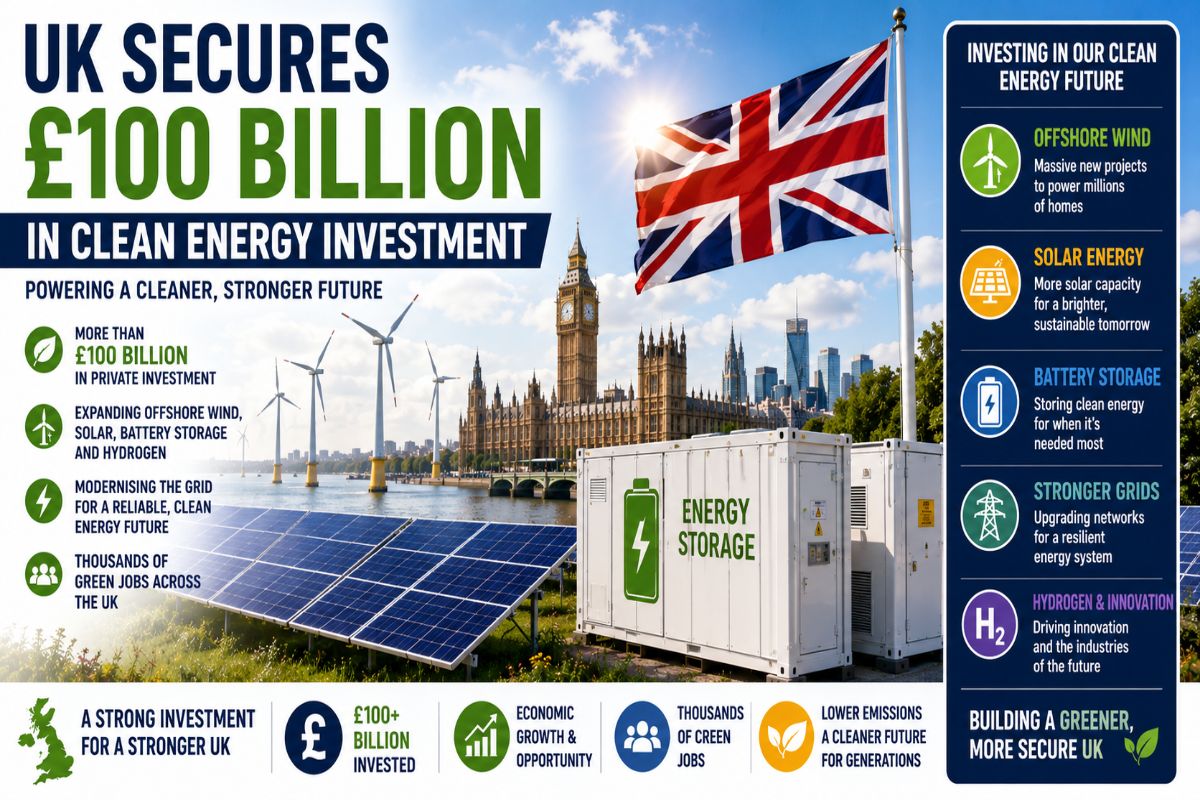
UK Secures £100 Billion in Clean Energy Investment to Accelerate Net Zero Goals
The United Kingdom has announced that it has secured more than £100 billion in private clean energy investment, marking a significant milestone in its transition toward a low-carbon economy. The investment will support renewable energy generation, battery storage, electricity networks, hydrogen projects, and offshore wind developments while creating thousands of skilled jobs across the country.
The funding is expected to strengthen the UK's energy security, reduce dependence on imported fossil fuels, and help achieve the country's legally binding net-zero emissions target. According to the UK government, the investments will accelerate the deployment of clean technologies while stimulating economic growth and regional development.
📌 Key Highlights
- More than £100 billion secured for clean energy projects.
- Major investments in offshore wind, solar energy, battery storage, and electricity networks.
- Expansion of hydrogen and carbon capture technologies.
- Thousands of new green jobs expected across the UK.
- Supports Britain's long-term energy security and Net Zero ambitions.
Where Will the Investment Be Used?
The funding will support large-scale renewable energy infrastructure including offshore wind farms, utility-scale solar projects, battery energy storage systems, upgraded transmission networks, green hydrogen facilities, and carbon capture technologies. These projects aim to modernize the UK's electricity system while attracting further private-sector investment.
Benefits for the UK Economy
- Creation of skilled clean-energy jobs.
- Improved energy independence.
- Reduced greenhouse gas emissions.
- Modernization of the national electricity grid.
- Growth in renewable energy manufacturing and innovation.
Supporting Net Zero
The investment package is a key part of the UK's strategy to achieve net-zero greenhouse gas emissions. Expanding renewable electricity generation and modernizing grid infrastructure will help power homes, industries, electric vehicles, and emerging technologies with cleaner energy.
Challenges Ahead
Delivering these projects will require faster planning approvals, expanded electricity transmission capacity, continued private-sector investment, and the development of a skilled workforce capable of supporting the growing renewable energy sector.
Future Outlook
The UK's clean energy investment strategy positions the country as one of Europe's leading destinations for renewable energy development. Continued investment in offshore wind, battery storage, hydrogen, and smart grid technologies is expected to strengthen long-term energy security while supporting sustainable economic growth.
Frequently Asked Questions (FAQ)
Why is the UK investing in clean energy?
The investment aims to improve energy security, reduce carbon emissions, create jobs, and accelerate the country's transition toward a low-carbon economy.
Which sectors will benefit most?
Offshore wind, solar energy, battery storage, hydrogen production, electricity transmission, and carbon capture projects will receive significant investment.
How much investment has been secured?
More than £100 billion in private clean energy investment has been announced.
How will this affect consumers?
Modern energy infrastructure can improve grid reliability, strengthen energy security, and support greater use of renewable electricity over the long term.
Will this create jobs?
Yes. Thousands of skilled jobs are expected in construction, engineering, manufacturing, operations, and renewable energy services.
How does this support Net Zero?
Expanding renewable electricity generation and modernizing the power grid will help reduce greenhouse gas emissions while supporting cleaner industries and transportation.
Related SolSetu Articles
- Australia's Battery Subsidies Drive Record Rooftop Solar Growth in 2026
- Canada Launches National Electricity Strategy to Double Power Generation by 2050
- U.S. Plans Record 43.4 GW of Utility-Scale Solar Capacity in 2026
- Virtual Power Plants (VPPs): The Future of Smart Renewable Energy Grids
Source: UK Government, Department for Energy Security and Net Zero.




Leave a Reply