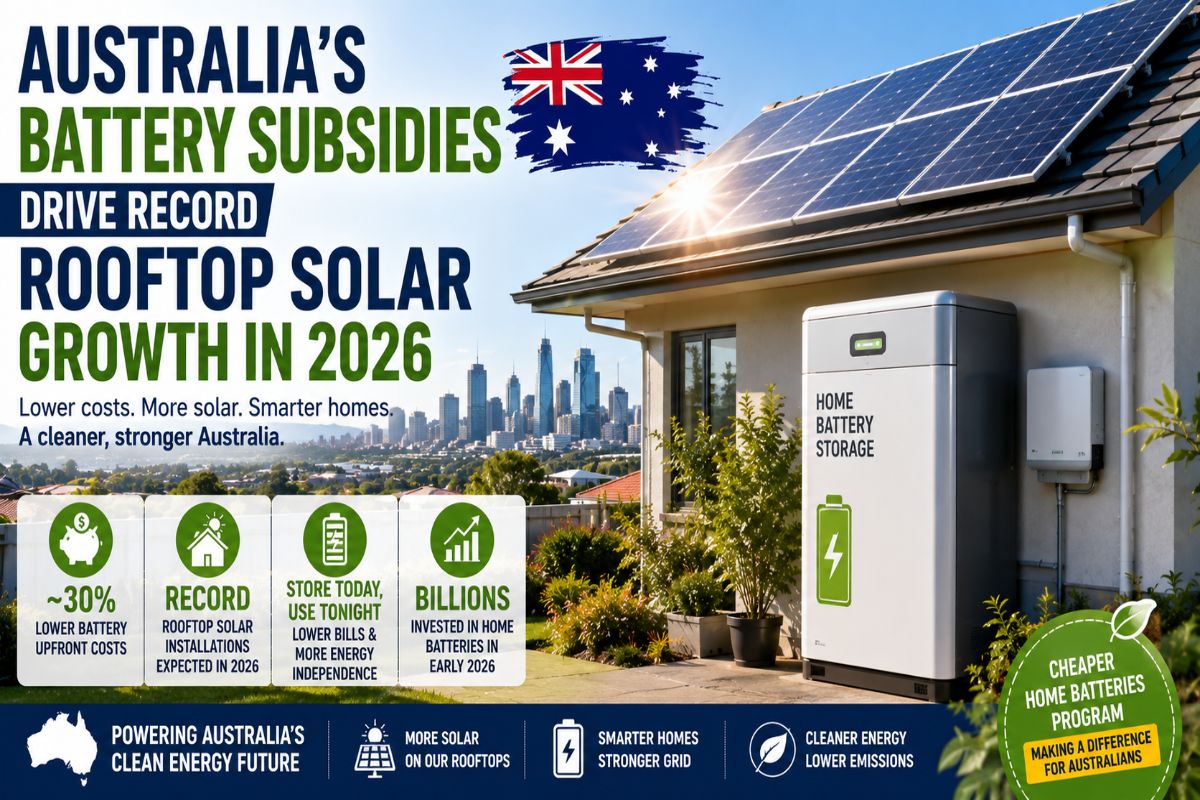
Australia's Battery Subsidies Drive Record Rooftop Solar Growth in 2026
Australia is experiencing a new wave of rooftop solar adoption after the expansion of the federal Cheaper Home Batteries Program. The enhanced subsidy has reduced the upfront cost of installing home battery systems, encouraging more households to pair batteries with rooftop solar installations.
The surge in battery adoption is helping Australians reduce electricity bills while improving the stability of the national electricity grid. Industry analysts expect rooftop solar installations to reach record levels during 2026 as demand for battery-backed solar systems continues to grow.
📌 Key Highlights
- Federal battery subsidy reduces installation costs by around 30%.
- Australians invested billions of dollars in home battery systems during the first months of 2026.
- Rooftop solar installations are forecast to reach a record 4 GW this year.
- Battery storage shifts excess daytime solar energy to evening demand.
- Coal-fired electricity generation continues to decline as renewable energy expands.
Why Home Batteries Are Becoming Popular
Home batteries allow households to store surplus solar electricity generated during the day and use it after sunset. This reduces dependence on the electricity grid, lowers power bills, and increases energy independence. The federal rebate has made battery systems significantly more affordable for many homeowners.
Benefits for Australia's Electricity Grid
- Improves grid stability during evening peak demand.
- Reduces pressure on transmission infrastructure.
- Supports higher renewable energy penetration.
- Lowers wholesale electricity prices.
- Reduces greenhouse gas emissions.
Growing Role of Distributed Energy
Australia already has one of the world's highest rates of rooftop solar adoption. The rapid growth of household batteries is transforming homes into distributed energy resources that can contribute to a cleaner and more resilient electricity system. Regulators report that battery and solar installations are increasingly being deployed together as integrated systems.
Challenges
Despite strong demand, many Australians—including renters and apartment residents—still face barriers to installing rooftop solar and batteries. Policymakers are exploring additional programs to improve access to clean energy technologies across all communities.
Future Outlook
Australia's combination of abundant sunshine, supportive government policies, and falling battery costs is expected to keep rooftop solar and home battery installations growing. These distributed energy systems will play an increasingly important role in supporting the country's clean energy transition.
Frequently Asked Questions (FAQ)
What is Australia's Cheaper Home Batteries Program?
It is a federal incentive program that reduces the upfront cost of installing eligible home battery storage systems.
Why are batteries important for rooftop solar?
Batteries store excess solar electricity produced during the day so it can be used at night or during periods of high electricity demand.
Will battery systems reduce electricity bills?
Many homeowners can reduce electricity costs by storing and using more of their own solar energy instead of purchasing electricity from the grid.
How do batteries help the electricity grid?
Battery systems help balance electricity supply and demand, reducing peak loads and improving grid reliability.
Is Australia a global leader in rooftop solar?
Yes. Australia has one of the highest levels of rooftop solar adoption in the world, with continued rapid growth in battery-backed systems.
What does this mean for renewable energy?
Greater adoption of rooftop solar and battery storage supports Australia's transition toward a cleaner, lower-carbon electricity system.
Related SolSetu Articles
- Canada Launches National Electricity Strategy to Double Power Generation by 2050
- U.S. Plans Record 43.4 GW of Utility-Scale Solar Capacity in 2026
- Virtual Power Plants (VPPs): The Future of Smart Renewable Energy Grids
- Green Hydrogen Storage: Powering the Future of Clean Energy
Source: Reuters, Clean Energy Regulator Australia.



Leave a Reply