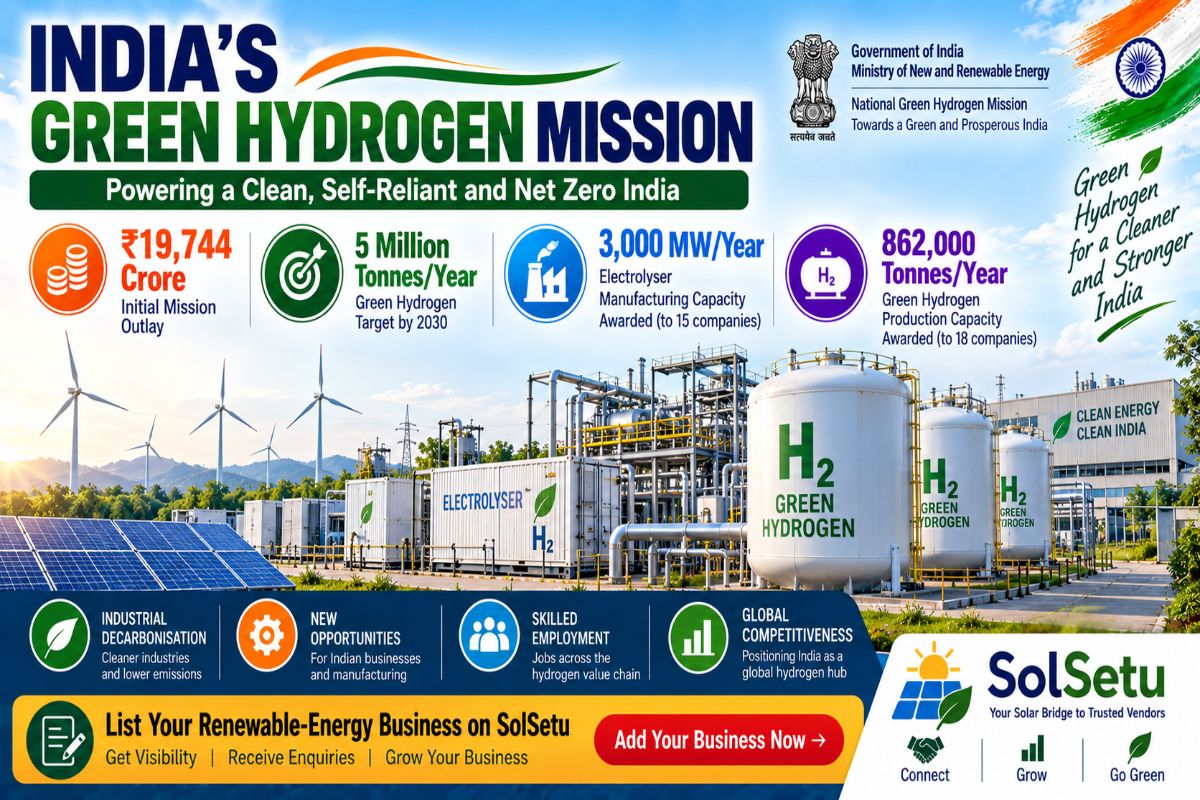
India's Green Hydrogen Mission: ₹19,744 Crore Investment Framework and Emerging Business Opportunities
India's green hydrogen industry is moving from policy development towards manufacturing, production and industrial deployment. The National Green Hydrogen Mission, approved with an initial government outlay of ₹19,744 crore, aims to position India as a global hub for green hydrogen production, consumption and exports.
The programme is supporting electrolyser manufacturing, green hydrogen production, green ammonia procurement, research, pilot projects and skills development. These activities could create opportunities for renewable-energy developers, equipment manufacturers, engineering companies, industrial consumers and specialist service providers.
In a government update published in March 2026, the Ministry of New and Renewable Energy reported awards covering 3,000 MW per year of electrolyser manufacturing capacity and 862,000 metric tonnes per year of green hydrogen production capacity. The government also reported price discovery for 724,000 metric tonnes per year of green ammonia supply to 13 fertiliser units.
Meanwhile, MNRE published an October 2026 expression of interest seeking expert institutional support for the Hydrogen Safety Panel, reflecting the continuing importance of standards, technical expertise and safe deployment.
Official sources: National Green Hydrogen Mission | Government's March 2026 progress update.
Are You a Renewable-Energy or Industrial Technology Business?
Showcase your products, engineering capabilities, projects and services to potential customers through SolSetu.
What Is the National Green Hydrogen Mission?
The National Green Hydrogen Mission is India's national programme for developing a green hydrogen economy.
It was approved by the Union Cabinet in January 2023 with an initial outlay of ₹19,744 crore. Its overarching objective is to make India a global hub for the production, use and export of green hydrogen and its derivatives.
Green hydrogen is generally produced by splitting water into hydrogen and oxygen using electricity from renewable sources. The emissions associated with the complete production pathway depend on the electricity supply, equipment, process and other lifecycle factors.
Hydrogen can be used as an industrial feedstock or energy carrier. It can also be converted into derivatives such as green ammonia and green methanol for selected industrial and energy applications.
Key Facts About India's Green Hydrogen Mission
| Parameter | Programme Detail |
|---|---|
| Initial mission outlay | ₹19,744 crore |
| Target for annual green hydrogen production by 2030 | 5 million metric tonnes |
| Electrolyser manufacturing capacity awarded, as reported in March 2026 | 3,000 MW per year |
| Green hydrogen production capacity awarded, as reported in March 2026 | 862,000 metric tonnes per year |
| Green ammonia supply for which prices were discovered | 724,000 metric tonnes per year |
| Fertiliser units covered by the reported green ammonia procurement | 13 units |
| Nodal ministry | Ministry of New and Renewable Energy (MNRE) |
Important distinction: Awarded capacity is not the same as installed capacity or actual annual production. These figures describe programme awards and procurement developments reported by the government, not proof that every project is already operating at full capacity.
How Does Green Hydrogen Production Work?
A common production method is water electrolysis. An electrolyser uses electricity to split water into hydrogen and oxygen. When the electricity comes from qualifying renewable sources and the production pathway meets the applicable criteria, the hydrogen may qualify as green hydrogen under the relevant framework.
A typical renewable hydrogen project may include:
- Solar, wind or other eligible renewable electricity
- Water sourcing and treatment systems
- An electrolyser stack and balance-of-plant equipment
- Power conversion and electrical control systems
- Hydrogen purification and drying equipment
- Compression and storage systems
- Pipelines or transport arrangements, where required
- Safety monitoring, controls and emergency systems
- Industrial process integration or hydrogen derivatives production
Project design depends on the hydrogen application, production scale, electricity profile, water availability, operating pressure, delivery requirements and local regulations.
What Is India's 2030 Green Hydrogen Target?
The National Green Hydrogen Mission sets a target of developing green hydrogen production capacity of at least 5 million metric tonnes per year by 2030.
Achieving this ambition requires more than installing electrolysers. India also needs sufficient renewable electricity, competitive project economics, industrial demand, suitable water resources, reliable equipment, transport infrastructure and clear safety standards.
Potential demand centres include refineries, fertiliser production, steelmaking and other industries where hydrogen is already used or could replace fossil-based feedstocks and fuels in technically suitable applications.
Exports of hydrogen derivatives may also become an opportunity where production costs, certification, transport infrastructure and international demand support commercially viable projects.
Electrolyser Manufacturing: An Emerging Industrial Opportunity
Electrolysers are a central technology in renewable hydrogen production. The National Green Hydrogen Mission includes financial support mechanisms for domestic electrolyser manufacturing.
In March 2026, the government reported that 3,000 MW per year of electrolyser manufacturing capacity had been awarded to 15 companies.
This manufacturing ecosystem may create demand for:
- Electrolyser stacks and system integration
- Power electronics and rectifiers
- Industrial pumps and water-treatment equipment
- Valves, piping and process instrumentation
- Gas purification and separation systems
- Control systems and industrial automation
- Pressure monitoring and safety equipment
- Testing, commissioning and maintenance services
Suppliers should review individual procurement specifications, certification requirements, quality standards and delivery conditions before entering the market.
Green Hydrogen Production: What Do the Award Figures Mean?
The government reported that 862,000 metric tonnes per year of green hydrogen production capacity had been awarded to 18 companies as of its March 2026 update.
These awards indicate a developing project pipeline. Actual production will depend on project commissioning, renewable electricity availability, plant utilisation, offtake agreements, financing and operating performance.
Potential project participants include:
- Renewable power developers
- Hydrogen project developers
- Electrolyser suppliers and integrators
- Industrial engineering and EPC companies
- Water-treatment and process-equipment providers
- Hydrogen compression and storage specialists
- Industrial gas companies
- Safety, testing and inspection service providers
Why Is Green Ammonia Important?
Green ammonia is produced using hydrogen made through a qualifying renewable-powered pathway, combined with nitrogen. Ammonia is an important input for fertiliser manufacturing and can also have potential roles in other industrial and energy applications.
India's fertiliser sector is therefore an important potential source of demand for lower-emission ammonia.
In March 2026, the government reported that the Solar Energy Corporation of India had discovered prices for the production and supply of 724,000 metric tonnes per year of green ammonia to 13 fertiliser units.
This represents a procurement milestone, but it should not be confused with confirmation that all contracted green ammonia is already being delivered.
Green ammonia projects require coordination across renewable electricity, electrolysis, nitrogen separation, ammonia synthesis, storage, transport and industrial offtake.
Which Industries Could Use Green Hydrogen?
1. Fertiliser Manufacturing
Hydrogen is used in ammonia production, which is a key input for nitrogen fertilisers. Renewable hydrogen can potentially reduce the emissions associated with conventional fossil-based hydrogen, subject to the project's lifecycle performance.
2. Petroleum Refining
Refineries use hydrogen in several processes. Green hydrogen may replace a portion of existing hydrogen demand where technically and economically suitable.
3. Steel and Metals
Hydrogen-based direct reduction is being developed as a potential pathway for reducing emissions in ironmaking. Commercial viability depends on ore quality, energy costs, technology and plant integration.
4. Green Chemicals and Methanol
Renewable hydrogen can be combined with suitable carbon sources to produce lower-emission chemical products. The environmental benefit depends on feedstock sourcing and the full production pathway.
5. Shipping and Other Energy Applications
Hydrogen derivatives may have roles in selected shipping fuels and energy applications. Infrastructure, safety, conversion losses and cost remain important considerations.
What Support Does the Mission Provide?
The mission's initial outlay of ₹19,744 crore includes multiple components rather than a single grant available to every project.
The original allocation includes:
- ₹17,490 crore for the Strategic Interventions for Green Hydrogen Transition (SIGHT) programme
- ₹1,466 crore for pilot projects
- ₹400 crore for research and development
- ₹388 crore for other mission components
The SIGHT programme includes support mechanisms for electrolyser manufacturing and green hydrogen production. Other mission activities cover pilots, research, skills and enabling infrastructure.
Eligibility, incentive rates, selection procedures, implementation timelines and payment conditions depend on the specific scheme and its applicable guidelines.
Businesses should not assume that the full mission outlay is available as a direct subsidy or that every hydrogen-related project automatically qualifies for financial support.
Official information: MNRE Hydrogen Schemes and Guidelines.
Hydrogen Safety and Standards: A Key 2026 Development
Hydrogen's physical properties create specific requirements for equipment selection, storage, ventilation, leak detection, pressure control and emergency response.
On 14 October 2026, MNRE published an expression of interest for an expert institution to support the Hydrogen Safety Panel under the National Green Hydrogen Mission. The notice lists 2 November 2026 as its end date.
This is a specialised institutional opportunity, not a general subsidy application for hydrogen companies.
The wider safety agenda includes:
- Hydrogen production and process safety
- Storage and compression system integrity
- Leak detection and monitoring
- Safe transport and handling
- Equipment testing and standards
- Worker training and emergency preparedness
Companies planning hydrogen facilities should engage qualified engineering and safety professionals and comply with all applicable standards, permissions and statutory requirements.
Official notice: MNRE Hydrogen Safety Panel EOI.
Green Hydrogen Business Opportunities for EPC Contractors
Green hydrogen projects bring together renewable power, industrial process equipment, electrical infrastructure, storage and safety systems. This creates potential opportunities for companies with relevant technical qualifications.
Areas to monitor include:
- Renewable power supply and integration
- Electrolyser installation and balance-of-plant EPC
- Industrial electrical systems and substations
- Water treatment and process engineering
- Hydrogen compression, storage and handling
- Industrial pipelines and gas systems
- Green ammonia and chemical process equipment
- Instrumentation, controls and automation
- Safety engineering and inspection
- Plant commissioning and long-term maintenance
Project owners may require previous experience, financial qualification, certified equipment, safety systems and performance guarantees. Smaller companies may find opportunities as specialist subcontractors or qualified component suppliers.
Challenges Facing India's Green Hydrogen Industry
1. Renewable Electricity Costs
Electricity is a major input to electrolysis. Competitive renewable power and high plant utilisation are important to reducing hydrogen production costs.
2. Water Availability
Electrolysis requires treated water. Projects must evaluate local water availability, treatment requirements and the environmental implications of sourcing and discharge.
3. Storage and Transportation
Hydrogen has a low volumetric energy density under ordinary conditions. Moving it can require compression, specialised storage, pipelines or conversion into derivatives, each with additional costs and technical requirements.
4. Industrial Offtake
Producers need reliable customers and commercially workable contracts. Long-term offtake arrangements can be essential to project financing.
5. Safety and Certification
Hydrogen facilities require appropriate standards, trained personnel, robust engineering and compliance with applicable regulations. Certification is also important when selling products into markets with defined emissions criteria.
6. Technology and Project Execution
Electrolyser performance, degradation, maintenance, renewable power variability and process integration can affect output and cost. Project developers must evaluate lifecycle economics rather than relying only on announced capacity.
How Can Businesses Prepare for Green Hydrogen Opportunities?
Businesses looking to enter the sector can begin with a practical market-readiness plan:
- Choose a market segment: electrolyser components, electrical EPC, renewable power, water treatment, process equipment, storage, safety or maintenance.
- Review official tenders: monitor MNRE, SECI and relevant project-owner procurement notices.
- Build technical credentials: prepare company profiles, references, certifications, quality systems and safety documentation.
- Develop partnerships: connect with experienced technology providers, industrial customers and engineering contractors.
- Assess project economics: evaluate power supply, water, utilisation, offtake, transport and maintenance requirements.
- Follow standards: monitor applicable hydrogen safety, equipment and certification requirements.
- Verify eligibility: read the relevant scheme documents before relying on any incentive or grant.
Grow Your Renewable-Energy Business with SolSetu
As India's clean-energy industry expands into hydrogen, storage and industrial decarbonisation, businesses need effective ways to present their technical capabilities and reach potential customers.
SolSetu — Your Solar Bridge to Trusted Vendors is an Indian renewable-energy business directory and knowledge platform.
Businesses can use SolSetu to:
- Showcase their company, products and services
- Present project experience and technical capabilities
- Improve online visibility
- Create a professional business profile
- Access listing and promotion features included in their chosen plan
- Receive potential customer enquiries through available listing features
Business listing plans start from ₹999 for 30 days, subject to current plan details and terms.
👉 Add Your Business on SolSetu
Conclusion
India's National Green Hydrogen Mission provides a policy and funding framework for developing renewable hydrogen production, domestic electrolyser manufacturing, green ammonia procurement and related industrial capabilities.
The government-reported awards for electrolyser manufacturing and hydrogen production indicate a developing project pipeline. Turning those awards into sustained industrial output will require competitive renewable electricity, reliable equipment, viable offtake arrangements, infrastructure, skilled personnel and strong safety practices.
For EPC contractors, component manufacturers, renewable power developers, industrial service providers and engineering consultants, green hydrogen is a sector worth monitoring through official scheme guidelines and procurement notices.
Companies that build credible technical capabilities and partnerships will be better positioned to assess opportunities as projects progress.
Connect Your Business to India's Clean-Energy Growth
Showcase your products, services and renewable-energy expertise through SolSetu.
LIST YOUR BUSINESS ON SOLSETU →
SolSetu — Your Solar Bridge to Trusted Vendors.




Leave a Reply