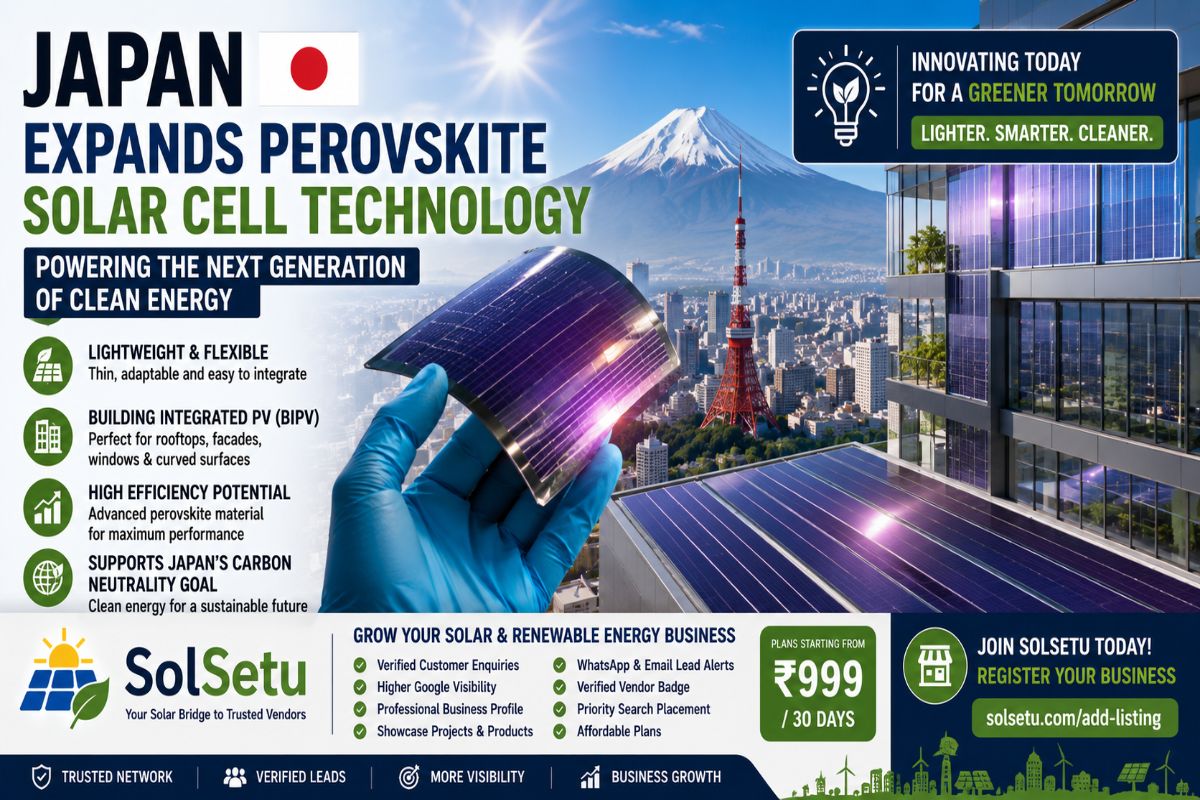
Japan Expands Perovskite Solar Cell Technology for Next-Generation Clean Energy
Japan is accelerating the commercialization of perovskite solar cell technology to expand renewable energy generation in urban environments. Lightweight, flexible, and highly adaptable, perovskite solar cells have the potential to transform rooftops, building facades, windows, and other surfaces into clean electricity generators.
As cities face increasing energy demand and limited rooftop space, Japan is investing in advanced photovoltaic technologies that can be integrated into buildings without requiring conventional solar panel installations. Perovskite solar cells are expected to play an important role in the country's long-term energy security and carbon neutrality strategy.
📌 Key Highlights
- Expansion of perovskite solar cell manufacturing.
- Development of flexible photovoltaic technology.
- Building-integrated solar applications.
- Supports Japan's carbon neutrality goals.
- Advances next-generation renewable energy innovation.
What Are Perovskite Solar Cells?
Perovskite solar cells are a new generation of photovoltaic technology that uses a perovskite-structured material to convert sunlight into electricity. Unlike conventional silicon solar panels, they can be manufactured as lightweight, flexible, and semi-transparent modules suitable for a wide range of applications.
Advantages of Perovskite Solar Technology
- Lightweight and flexible design.
- High efficiency potential.
- Suitable for building-integrated photovoltaics (BIPV).
- Can be installed on curved surfaces.
- Lower material consumption.
- Supports urban renewable energy generation.
- Potential for cost-effective manufacturing.
Urban Renewable Energy Applications
Perovskite solar cells can be incorporated into office buildings, residential apartments, shopping centers, railway stations, airports, warehouses, and smart city infrastructure. Their flexibility enables renewable electricity generation in locations where traditional solar panels may not be practical.
Challenges
Researchers continue working to improve long-term durability, moisture resistance, and large-scale manufacturing processes. Ongoing innovation is expected to enhance the commercial viability of perovskite solar technology over the coming years.
Future Outlook
Japan's investment in perovskite solar cells demonstrates its commitment to next-generation clean energy technologies. As production scales and efficiency improves, these lightweight solar modules could become a significant contributor to global renewable electricity generation and sustainable urban development.
🚀 Grow Your Solar & Renewable Energy Business with SolSetu
Are you a Solar EPC Company, Installer, Dealer, Distributor, Manufacturer, BIPV Solution Provider, Battery Supplier, EV Charging Company, or Renewable Energy Consultant?
Join SolSetu – Your Solar Bridge to Trusted Vendors and connect with homeowners, businesses, industries, and government organizations searching for trusted renewable energy professionals across India.
Benefits of Listing on SolSetu
- ✅ Verified customer enquiries.
- ✅ Higher Google visibility.
- ✅ Professional business profile.
- ✅ Showcase projects, products, certifications, and completed installations.
- ✅ WhatsApp & Email lead alerts.
- ✅ Verified Vendor Badge.
- ✅ Priority Search Placement.
- ✅ Affordable plans starting from ₹999 for 30 Days.
👉 Register Your Business Today:
https://solsetu.com/add-listing/
Frequently Asked Questions (FAQ)
What are perovskite solar cells?
Perovskite solar cells are a next-generation photovoltaic technology that uses perovskite materials to convert sunlight into electricity with the potential for lightweight and flexible designs.
Why is Japan investing in perovskite solar technology?
Japan aims to expand renewable energy generation in urban areas, improve energy security, and support its carbon neutrality goals through advanced solar technologies.
What is Building-Integrated Photovoltaics (BIPV)?
BIPV integrates solar power generation directly into buildings through roofs, walls, windows, and facades, allowing structures to generate electricity while serving their primary architectural function.
What are the advantages over traditional silicon panels?
Perovskite solar cells are lighter, flexible, can be semi-transparent, and are suitable for surfaces where conventional rigid panels cannot easily be installed.
Who can register on SolSetu?
Solar EPC companies, manufacturers, installers, BIPV solution providers, battery suppliers, distributors, EV charging companies, and renewable energy consultants can create a professional business listing.
How can SolSetu help renewable energy businesses?
SolSetu helps businesses receive verified customer enquiries, improve Google visibility, showcase completed projects, and connect with customers actively searching for renewable energy solutions.
Related SolSetu Articles
- Netherlands Expands Offshore Solar Farms to Complement North Sea Wind Energy
- New Zealand Accelerates Geothermal Energy Projects
- Germany Expands Green Steel Production Using Renewable Hydrogen
- Australia Accelerates Utility-Scale Battery Storage



Leave a Reply