Perovskite Solar Cells: The Next Breakthrough in Solar Energy
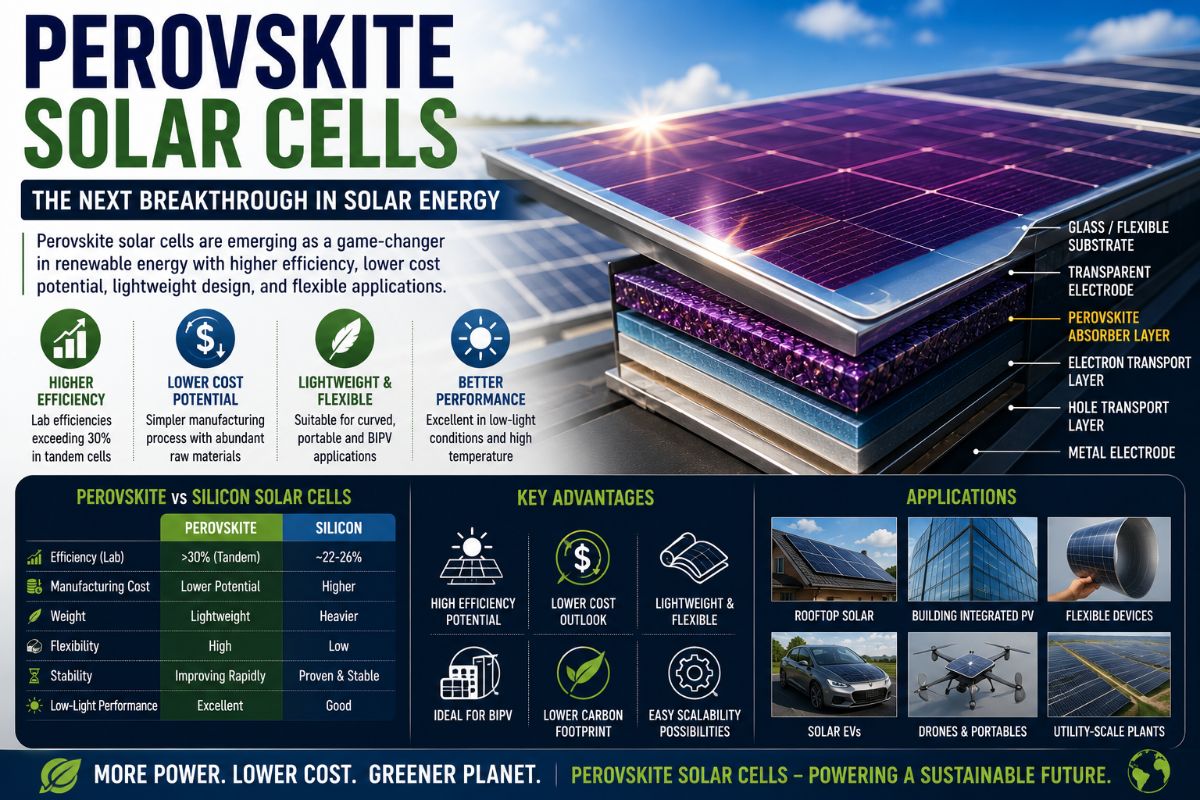
Perovskite solar cells are among the most promising innovations in photovoltaic technology. Unlike conventional silicon solar cells, these advanced devices use a perovskite-structured light-absorbing material that offers exceptional efficiency potential while reducing manufacturing complexity and cost.
Researchers worldwide are developing perovskite solar technology for residential rooftops, commercial buildings, flexible electronics, and utility-scale solar farms. Combined with silicon in tandem solar cells, perovskites could significantly increase the amount of electricity generated from the same amount of sunlight.
📌 Key Takeaways
- Technology: Perovskite Solar Cells
- Sector: Advanced Solar Photovoltaics
- Primary Benefit: Higher efficiency with lightweight and flexible solar modules.
- Applications: Rooftop solar, utility-scale solar farms, Building-Integrated Photovoltaics (BIPV), vehicles, portable electronics, and smart buildings.
💡 Did You Know?
Perovskite-silicon tandem solar cells have demonstrated laboratory efficiencies above 30%, showing the potential to outperform many conventional silicon-only solar technologies under controlled testing conditions.
What Are Perovskite Solar Cells?
Perovskite solar cells are photovoltaic devices that use a crystalline material with a perovskite structure to absorb sunlight and convert it into electricity. These materials can be manufactured using relatively simple processes and may enable lighter, thinner, and more versatile solar panels.
How Perovskite Solar Cells Work
- Sunlight reaches the perovskite absorber layer.
- The material absorbs photons and generates electrical charges.
- Electrons and holes move through dedicated transport layers.
- An electric current flows through an external circuit.
- The generated electricity powers homes, businesses, or battery storage systems.
Perovskite vs Silicon Solar Panels
- Higher efficiency potential.
- Lower manufacturing temperature.
- Lighter and thinner construction.
- Flexible module designs.
- Excellent low-light performance.
- Potential for lower production costs.
Advantages of Perovskite Technology
- High energy conversion efficiency.
- Lightweight and flexible designs.
- Suitable for Building-Integrated Photovoltaics.
- Potentially lower manufacturing costs.
- Can be combined with silicon for tandem solar panels.
- Supports next-generation renewable energy systems.
Current Challenges
Researchers continue working to improve long-term stability, moisture resistance, large-scale manufacturing, and material durability. Overcoming these challenges is essential before widespread commercial deployment.
Future Outlook
Perovskite solar technology is expected to complement rather than replace traditional silicon panels. Tandem modules combining silicon and perovskite layers could become one of the most efficient commercial solar technologies in the coming years.
Frequently Asked Questions
What are perovskite solar cells?
Perovskite solar cells are advanced photovoltaic devices that use a perovskite-structured semiconductor material to convert sunlight into electricity.
Why are perovskite solar cells important?
They offer the potential for higher efficiency, lower manufacturing costs, lightweight construction, and flexible applications compared with many conventional solar technologies.
What are tandem solar cells?
Tandem solar cells combine two different photovoltaic materials, such as silicon and perovskite, to capture a broader range of sunlight and increase overall efficiency.
Can perovskite solar cells replace silicon panels?
In the near future, they are more likely to complement silicon through tandem designs rather than completely replace conventional silicon panels.
Where can perovskite solar cells be used?
Applications include rooftops, utility-scale solar farms, building facades, windows, portable electronics, vehicles, and flexible solar products.
Are perovskite solar panels commercially available?
Several companies are developing commercial products, while researchers continue improving durability and large-scale manufacturing for broader adoption.
Recommended Renewable Energy Products
WAAREE II 580–585W TOPCon Bifacial Solar Panel
High-efficiency bifacial solar panel designed for residential, commercial, and utility-scale solar installations.
Luminous NXG 1450e Solar Inverter
Reliable solar inverter for efficient renewable energy systems and dependable backup power.
Kenbrook Solar MC4 Crimping Tool Kit
Professional installation tool for secure MC4 connector assembly in photovoltaic systems.
Pure Copper Lightning Arrester
Provides dependable lightning and surge protection for renewable energy installations.
Related SolSetu Articles
- Gravity Energy Storage: The Future of Long-Duration Renewable Energy Storage
- Solar Canals: Generating Clean Energy While Saving Water
- Transparent Solar Windows: Turning Buildings into Clean Energy Generators
- Solid-State Batteries: The Future of Safer and Longer-Lasting Energy Storage
Affiliate Disclosure: This article contains affiliate links. SolSetu may earn a commission from qualifying purchases at no additional cost to buyers.




Leave a Reply