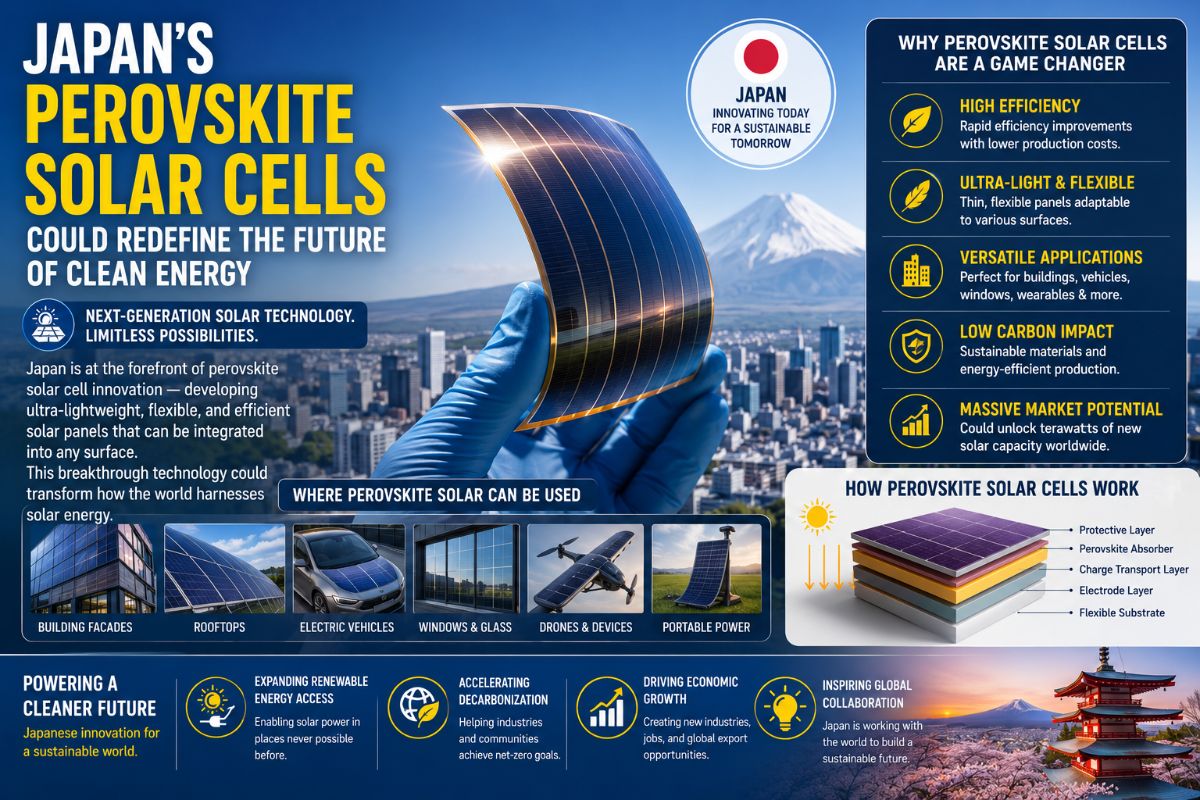
Japan's Perovskite Solar Cells Could Redefine the Future of Clean Energy
Japan is at the forefront of one of the most exciting breakthroughs in renewable energy—perovskite solar cells (PSCs). Unlike traditional silicon solar panels, perovskite solar cells are lightweight, flexible, semi-transparent, and can be manufactured at lower temperatures, opening new possibilities for clean electricity generation across urban environments.
Researchers and manufacturers are working to commercialize this next-generation photovoltaic technology for applications ranging from building facades and windows to electric vehicles, portable electronics, factories, railway stations, and smart cities. By integrating solar generation into everyday surfaces, perovskite technology has the potential to dramatically expand renewable energy capacity without requiring additional land.
As global demand for clean electricity continues to grow, Japan's investment in perovskite research is positioning the country as a leader in advanced photovoltaic innovation and sustainable energy technologies.
Why Perovskite Solar Cells Are Different
- Ultra-lightweight and flexible construction.
- High efficiency with continuous technological improvements.
- Suitable for curved, lightweight, and transparent surfaces.
- Lower manufacturing temperatures compared to silicon panels.
- Ideal for Building-Integrated Photovoltaics (BIPV).
- Potential for large-scale urban renewable energy generation.
Expanding Renewable Energy Beyond Rooftops
One of the greatest advantages of perovskite solar technology is its versatility. Flexible solar modules can be installed on skyscrapers, glass facades, public transportation systems, vehicles, warehouses, agricultural structures, and consumer electronics. This expands renewable electricity generation into areas where conventional rigid solar panels are difficult or impossible to deploy.
Combined with battery energy storage systems, artificial intelligence-based energy management, and smart grids, perovskite solar cells could significantly contribute to future carbon-neutral cities while reducing dependence on fossil fuels.
Recommended Renewable Energy Products

WAAREE II 580-585W TOPCon Bifacial Solar Panel (Pack of 2)
High-efficiency TOPCon bifacial solar panels suitable for residential, commercial, and industrial renewable energy installations.

Loom Solar Shark 600W TOPCon Bifacial Panel
Advanced photovoltaic technology delivering exceptional efficiency and long-term durability for modern solar installations.

Luminous NXG 1450e Solar Inverter
Reliable solar inverter designed for efficient renewable energy conversion and intelligent energy management.
Copper Lightning Arrester
Provides dependable protection for commercial solar plants, industrial buildings, research facilities, and renewable energy infrastructure.
Earthing Electrode
Professional grounding solution designed for solar installations, smart buildings, research laboratories, and utility-scale renewable energy systems.
Affiliate Disclosure: This article contains affiliate links. SolSetu may earn a commission from qualifying purchases at no additional cost to buyers.
Future Outlook
Although perovskite solar cells are still progressing toward widespread commercial deployment, rapid improvements in efficiency, durability, and large-scale manufacturing indicate a promising future. As Japan continues investing in research and industrial production, perovskite technology could complement conventional silicon panels and transform how renewable electricity is generated in cities around the world, accelerating the transition toward a cleaner and more sustainable energy future.


Leave a Reply