France Expands Offshore Floating Wind Farms for Clean Energy
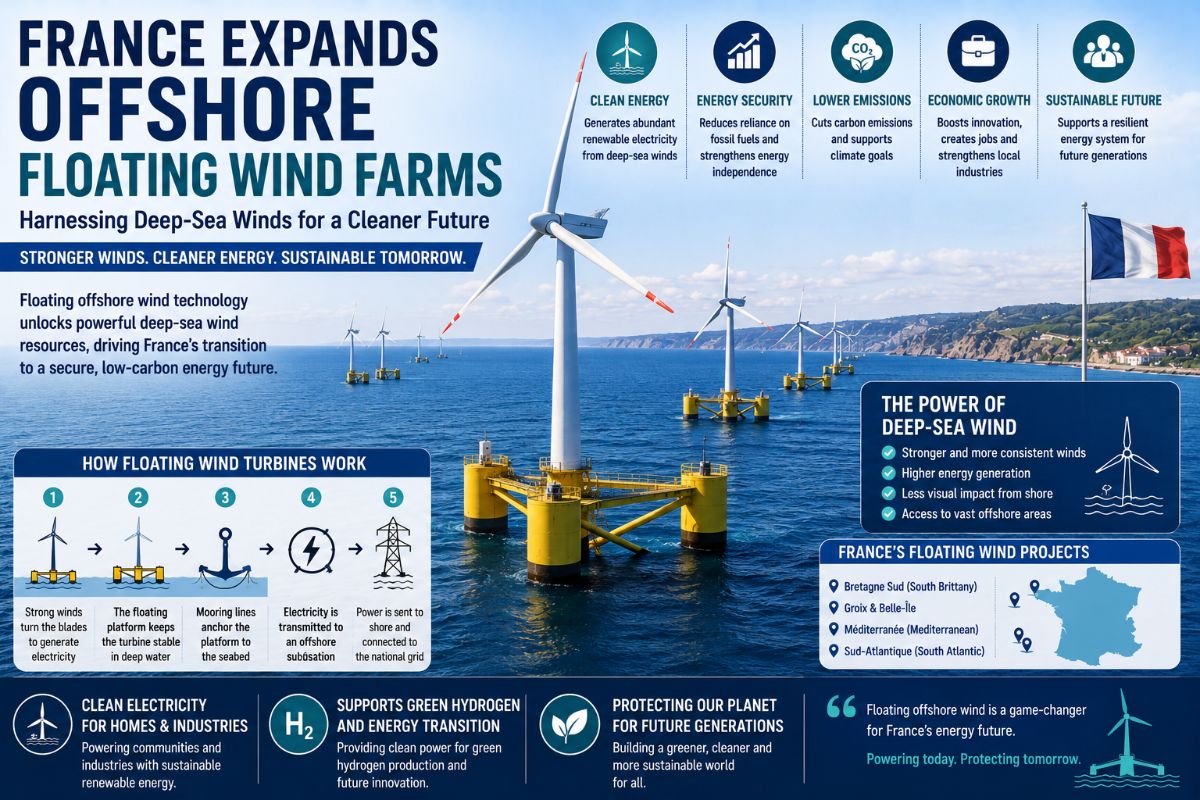
France is accelerating the deployment of floating offshore wind farms to harness strong and consistent winds in deep offshore waters. Unlike conventional offshore wind turbines that require fixed foundations, floating wind turbines are mounted on floating platforms anchored to the seabed, allowing renewable energy generation in much deeper waters.
Floating offshore wind technology significantly expands the areas available for wind energy development, helping France strengthen energy security, reduce greenhouse gas emissions, and support its long-term climate objectives.
📌 Key Takeaways
- Country: France
- Technology: Floating Offshore Wind
- Sector: Wind Energy
- Primary Benefit: Generates renewable electricity from deep-sea wind resources.
- Applications: National power grids, coastal industries, green hydrogen production, and clean electricity supply.
💡 Did You Know?
Floating offshore wind turbines can operate in waters deeper than 60 metres, opening access to powerful offshore wind resources that are unsuitable for conventional fixed-bottom wind farms.
What Is Floating Offshore Wind?
Floating offshore wind uses wind turbines mounted on floating structures that are secured to the seabed with mooring lines and anchors. This allows turbines to operate in deep-water locations where stronger and more consistent winds can generate higher amounts of renewable electricity.
How Floating Offshore Wind Works
- Floating platforms support large offshore wind turbines.
- Mooring systems anchor the platforms securely to the seabed.
- Strong offshore winds rotate the turbine blades.
- Generators convert mechanical energy into electricity.
- Subsea cables transport electricity to offshore substations.
- Power is transmitted to the national electricity grid.
Why France Is Investing in Floating Offshore Wind
- Utilize deep-water wind resources.
- Increase renewable electricity generation.
- Reduce dependence on fossil fuels.
- Support net-zero climate goals.
- Create jobs in offshore industries.
- Strengthen national energy security.
Benefits of Floating Offshore Wind
- Access to stronger and more consistent winds.
- Higher renewable electricity generation potential.
- Reduced visual impact compared with nearshore projects.
- Supports green hydrogen production.
- Creates skilled employment opportunities.
- Accelerates the clean energy transition.
Challenges
Floating offshore wind projects require advanced engineering, specialized installation vessels, strong subsea transmission infrastructure, and significant investment. Continued technological innovation is expected to reduce costs and improve commercial competitiveness over time.
Frequently Asked Questions
What is floating offshore wind?
Floating offshore wind is a renewable energy technology where wind turbines are installed on floating platforms anchored to the seabed instead of fixed foundations.
How are floating wind turbines anchored?
They are secured using mooring lines connected to anchors placed on the seabed, allowing the platform to remain stable while floating.
Why is France investing in floating offshore wind?
France is developing floating offshore wind farms to capture stronger deep-sea winds, expand renewable electricity generation, and reduce carbon emissions.
How is floating wind different from conventional offshore wind?
Conventional offshore wind turbines are fixed directly to the seabed in shallow waters, while floating wind turbines operate on floating platforms in much deeper waters.
Which countries are leading floating offshore wind?
France, Norway, the United Kingdom, Portugal, Spain, Japan, South Korea, and the United States are among the countries investing in floating offshore wind technology.
Can floating wind support green hydrogen production?
Yes. Offshore wind electricity can power electrolysers that produce green hydrogen for industrial and transportation applications.
Recommended Renewable Energy Products

WAAREE II 580–585W TOPCon Bifacial Solar Panel
High-efficiency bifacial solar panel for residential, commercial, and utility-scale renewable energy installations.

Luminous NXG 1450e Solar Inverter
Efficient solar inverter designed for dependable renewable energy systems.

Kenbrook Solar MC4 Crimping Tool Kit
Professional-grade installation tool for secure MC4 connector assembly.

Pure Copper Lightning Arrester
Provides dependable surge and lightning protection for renewable energy installations.
Related SolSetu Articles
- Australia Builds Renewable Energy Zones to Accelerate Clean Power
- Norway Deploys Green Shipping Corridors Powered by Clean Fuels
- India Expands Pumped Storage Hydropower for Renewable Energy Storage
- Germany Expands Agrivoltaics to Combine Farming and Solar Energy
Affiliate Disclosure: This article contains affiliate links. SolSetu may earn a commission from qualifying purchases at no additional cost to buyers.

Leave a Reply