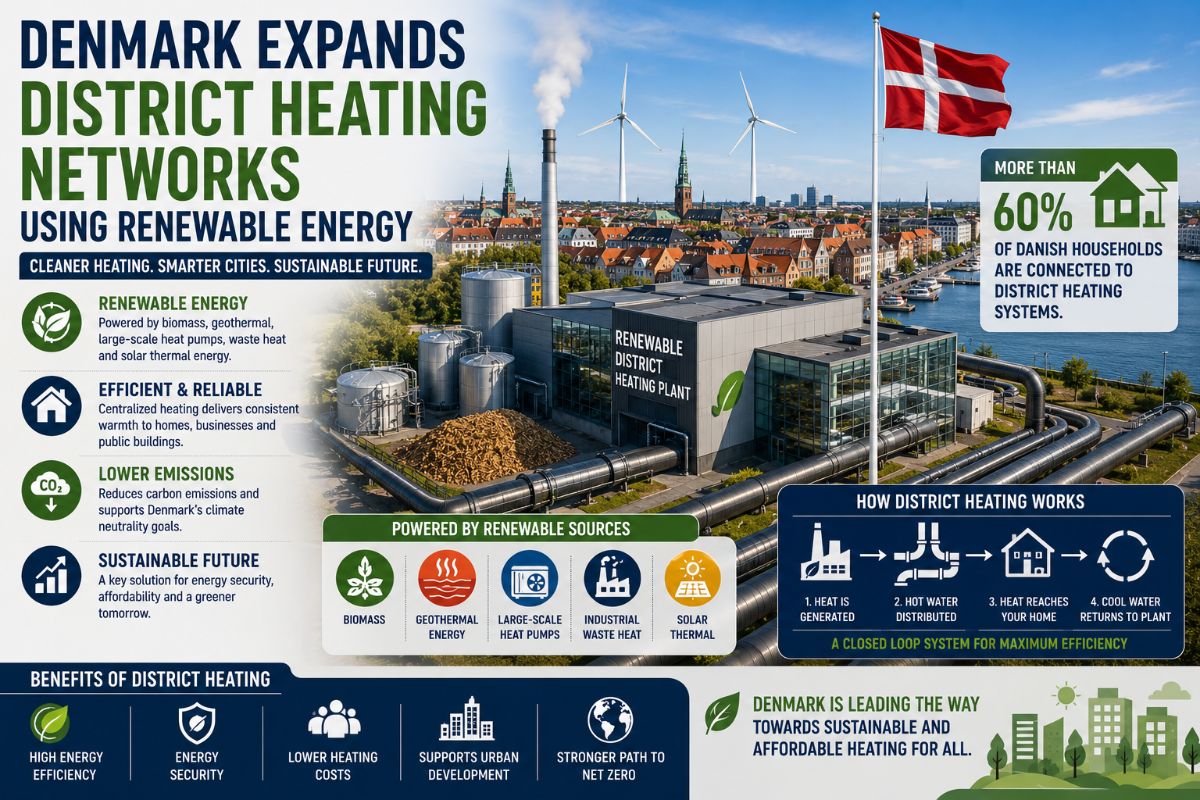
Denmark Expands Renewable District Heating Networks for Sustainable Cities
Denmark continues to lead the world in sustainable urban heating by expanding its renewable district heating networks. These centralized systems distribute hot water through insulated underground pipelines to thousands of homes, offices, schools, hospitals, and commercial buildings, replacing individual fossil-fuel boilers with cleaner, more efficient heating solutions.
By integrating renewable energy sources such as wind power, biomass, geothermal energy, large-scale heat pumps, and recovered industrial waste heat, Denmark is reducing greenhouse gas emissions while improving energy efficiency across its cities.
📌 Key Takeaways
- Country: Denmark
- Technology: Renewable District Heating
- Sector: Clean Heating & Urban Energy
- Primary Benefit: Provides efficient low-carbon heating for homes and businesses.
- Applications: Residential buildings, offices, hospitals, schools, universities, industries, and public infrastructure.
💡 Did You Know?
More than 60% of Danish households receive heat through district heating systems, making Denmark one of the world's leading examples of centralized, energy-efficient heating.
What Is District Heating?
District heating is a centralized heating system where hot water or steam is produced at one or more energy plants and delivered through insulated underground pipes to multiple buildings. Instead of every building operating its own boiler, the network supplies efficient, reliable heating from shared renewable energy sources.
How Renewable District Heating Works
- Renewable energy generates heat using biomass, geothermal energy, wind-powered heat pumps, or industrial waste heat.
- Water is heated at a central energy facility.
- Hot water flows through insulated underground pipelines.
- Heat exchangers transfer warmth to buildings.
- Cooled water returns to the plant for reheating.
- The cycle repeats continuously, delivering efficient low-carbon heating.
Why Denmark Is Investing in District Heating
- Reduce fossil fuel consumption.
- Lower greenhouse gas emissions.
- Improve urban energy efficiency.
- Increase renewable energy utilization.
- Strengthen national energy security.
- Support carbon-neutral city development.
Benefits of Renewable District Heating
- High energy efficiency.
- Lower carbon emissions.
- Reduced heating costs over time.
- Reliable heat supply.
- Uses multiple renewable energy sources.
- Supports sustainable urban development.
Challenges
District heating systems require significant upfront investment in underground pipeline infrastructure, centralized heating plants, and long-term urban planning. Expanding networks into existing cities can also present engineering and construction challenges.
Frequently Asked Questions
What is district heating?
District heating is a centralized system that distributes hot water or steam through underground pipelines to heat multiple buildings from shared energy sources.
Why is Denmark a leader in district heating?
Denmark has invested in district heating for decades, integrating renewable energy, efficient infrastructure, and advanced energy planning to reduce emissions and improve efficiency.
Which renewable energy sources power district heating?
District heating can use biomass, geothermal energy, large-scale heat pumps, industrial waste heat, solar thermal energy, and electricity generated from renewable sources.
Is district heating more efficient than individual boilers?
Yes. Centralized systems typically achieve higher efficiency, lower emissions, and better fuel utilization compared with individual heating systems.
Can other countries adopt district heating?
Yes. Countries with dense urban populations and supportive infrastructure can successfully implement renewable district heating systems.
How does district heating support climate goals?
It reduces fossil fuel consumption, increases renewable energy use, improves energy efficiency, and helps cities lower greenhouse gas emissions.
Recommended Renewable Energy Products

WAAREE II 580–585W TOPCon Bifacial Solar Panel
High-efficiency bifacial solar panel suitable for residential, commercial, and utility-scale renewable energy projects.

Luminous NXG 1450e Solar Inverter
Reliable solar inverter for efficient renewable energy systems and dependable backup power.

Kenbrook Solar MC4 Crimping Tool Kit
Professional installation tool for secure MC4 connector assembly in photovoltaic systems.

Pure Copper Lightning Arrester
Provides dependable lightning and surge protection for renewable energy installations.
Related SolSetu Articles
- South Korea Expands Smart Grids for a Smarter Renewable Energy Future
- Norway Scales Up Green Ammonia Production for Zero-Carbon Shipping
- Canada Expands Carbon Capture and Storage Projects to Reduce Industrial Emissions
- Germany Expands Agrivoltaics to Combine Farming and Solar Energy
Affiliate Disclosure: This article contains affiliate links. SolSetu may earn a commission from qualifying purchases at no additional cost to buyers.



Leave a Reply