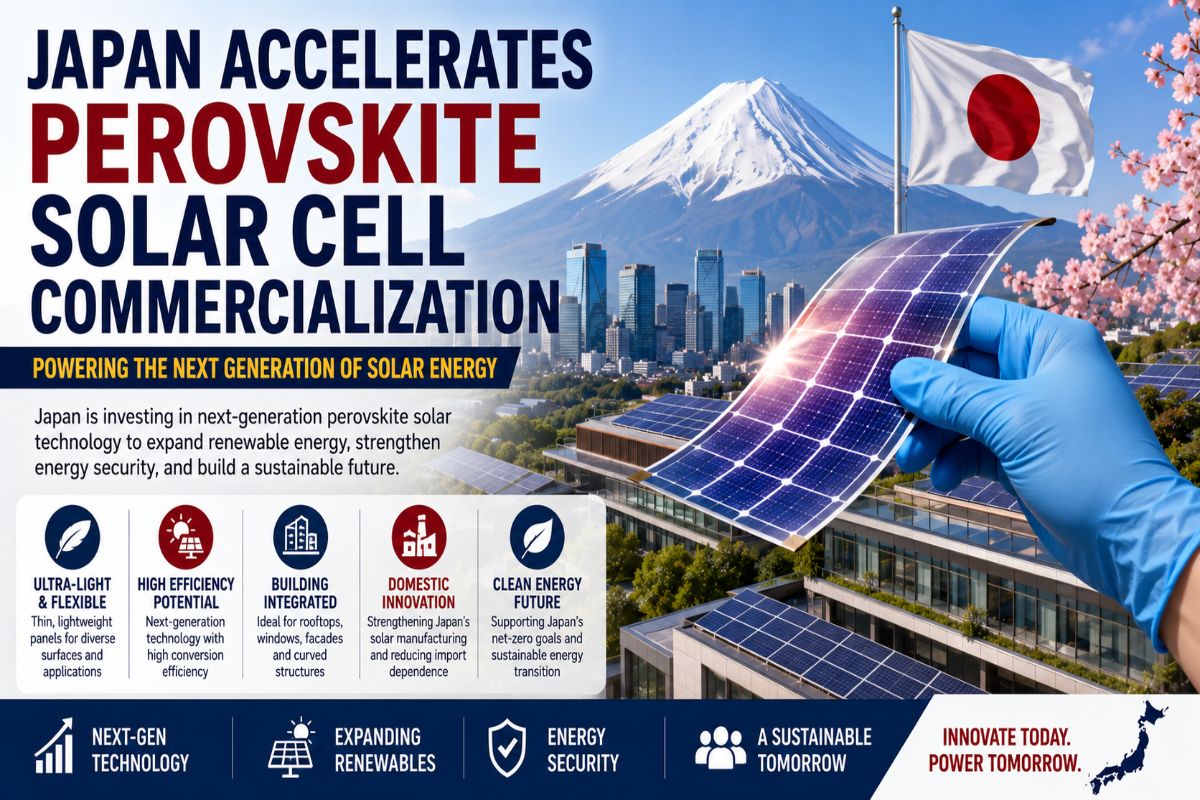
Japan Accelerates Perovskite Solar Cell Commercialization for Next-Generation Solar Energy
Japan is accelerating the commercialization of perovskite solar cells, an emerging photovoltaic technology expected to transform renewable energy production. Unlike conventional silicon panels, perovskite solar cells are lightweight, ultra-thin, and flexible, allowing installation on rooftops, building facades, windows, curved surfaces, and urban infrastructure.
The Japanese government is supporting research, domestic manufacturing, and commercial deployment of perovskite technology to strengthen energy security, reduce dependence on imported solar products, and accelerate the country's clean energy transition.
📌 Key Highlights
- Japan is investing heavily in perovskite solar technology.
- Perovskite panels are lightweight and flexible.
- Technology can be installed on buildings, windows, and curved surfaces.
- Supports Japan's renewable energy and energy security goals.
- Domestic production aims to strengthen the local solar manufacturing industry.
What Are Perovskite Solar Cells?
Perovskite solar cells use a special crystal-structured material that efficiently converts sunlight into electricity. They can be manufactured using lower-temperature processes than conventional silicon panels, potentially reducing production costs while enabling new applications that are difficult with traditional rigid modules.
Why Japan Is Investing
Japan has limited land available for large utility-scale solar farms. Lightweight perovskite solar panels can be integrated into buildings, transportation infrastructure, commercial facilities, and urban environments, increasing renewable electricity generation without requiring extensive land resources.
Advantages of Perovskite Solar Technology
- Lightweight construction.
- Flexible solar modules.
- High efficiency potential.
- Building-integrated photovoltaic applications.
- Lower manufacturing energy requirements.
- Supports domestic clean energy manufacturing.
Applications
- Residential rooftops.
- Commercial buildings.
- Glass facades and windows.
- Railway stations.
- Electric vehicles.
- Portable electronic devices.
Challenges
Researchers continue working to improve long-term durability, moisture resistance, and large-scale manufacturing consistency. These improvements will be essential before widespread commercial deployment.
Future Outlook
Japan aims to become a global leader in next-generation solar technology by combining innovation, advanced manufacturing, and supportive government policies. Successful commercialization of perovskite solar cells could significantly expand renewable electricity generation across densely populated urban areas.
Frequently Asked Questions (FAQ)
What are perovskite solar cells?
Perovskite solar cells are advanced photovoltaic devices that use a crystal-structured material to convert sunlight into electricity with high efficiency potential.
Why is Japan investing in perovskite solar technology?
Japan aims to strengthen energy security, expand renewable electricity generation, and develop a competitive domestic solar manufacturing industry.
How are perovskite panels different from silicon panels?
Perovskite panels are lighter, thinner, and flexible, making them suitable for buildings, windows, curved surfaces, and other innovative applications.
Can perovskite solar cells be installed on buildings?
Yes. Their lightweight and flexible design makes them suitable for rooftops, walls, windows, and building-integrated photovoltaic systems.
Are perovskite solar cells commercially available?
Commercial deployment is beginning, while researchers continue improving long-term stability and manufacturing processes.
Will perovskite technology replace silicon solar panels?
Perovskite technology is expected to complement silicon through tandem solar cells and specialized applications rather than completely replace conventional solar panels.
Related SolSetu Articles
- Germany Accelerates Grid-Scale Battery Storage to Strengthen Renewable Energy Grid
- UK Secures £100 Billion in Clean Energy Investment to Boost Renewable Energy and Jobs
- Australia's Battery Subsidies Drive Record Rooftop Solar Growth in 2026
- Future Energy Technologies: Perovskite Solar Cells
Source: Japan's renewable energy initiatives, industry announcements, and government-supported perovskite solar development programs.




Leave a Reply