Floating Offshore Wind Farms: Powering the Future of Deep-Sea Renewable Energy
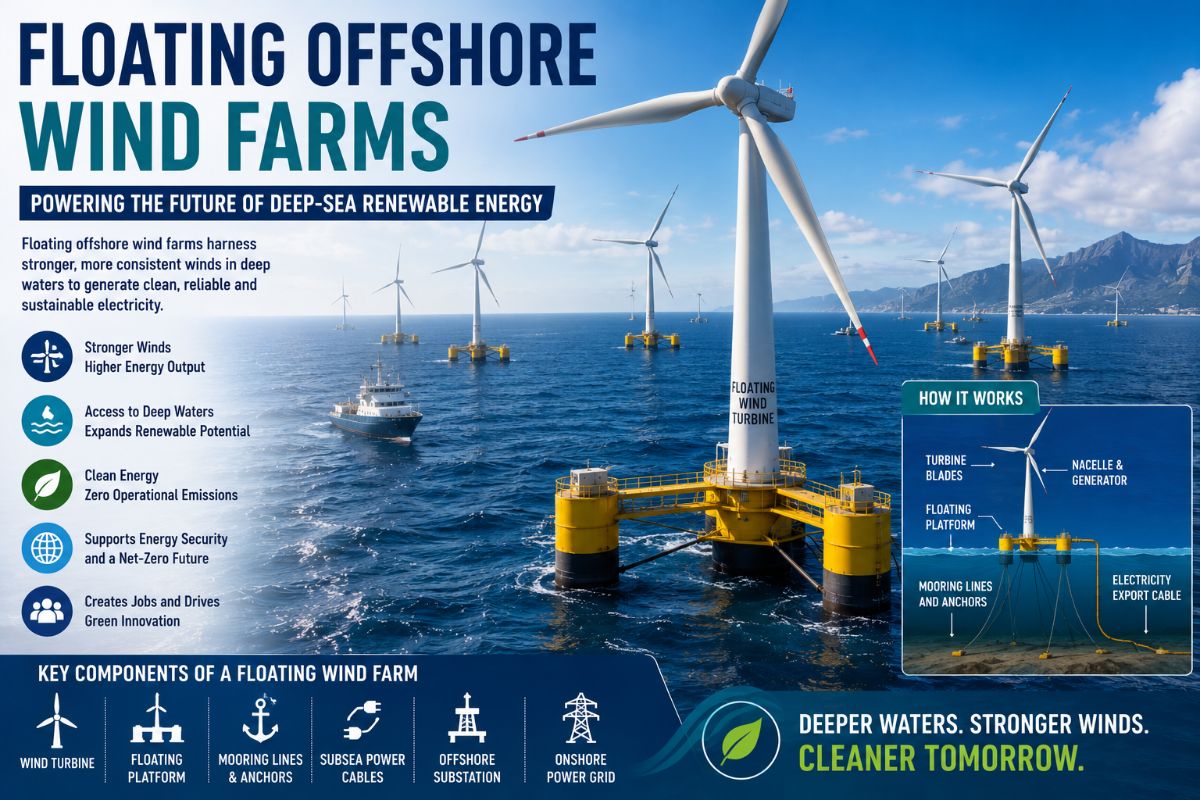
Floating offshore wind farms represent one of the most exciting innovations in renewable energy. Unlike traditional offshore wind turbines that are fixed to the seabed, floating wind turbines are mounted on floating platforms anchored to the ocean floor with mooring lines. This allows wind farms to be installed in much deeper waters where wind speeds are stronger, more consistent, and capable of producing more electricity.
As countries seek cleaner energy and larger renewable resources, floating offshore wind is becoming an important solution for expanding electricity generation while minimizing land use and reducing carbon emissions.
📌 Key Takeaways
- Technology: Floating Offshore Wind
- Sector: Wind Energy
- Primary Benefit: Harnesses stronger winds in deep-sea locations.
- Applications: Grid electricity, green hydrogen production, offshore industries, island power systems, and coastal communities.
💡 Did You Know?
Nearly 80% of the world's offshore wind resources are located in waters deeper than 60 meters, where conventional fixed-bottom turbines are often not practical. Floating platforms unlock access to these vast renewable energy resources.
What Are Floating Offshore Wind Farms?
Floating offshore wind farms consist of wind turbines installed on buoyant floating platforms. Instead of being permanently fixed to the seabed, the platforms are secured using anchors and mooring cables, allowing them to remain stable while generating electricity from offshore winds.
How Floating Offshore Wind Turbines Work
- Wind turns the turbine blades.
- The rotor drives a generator inside the nacelle.
- Electricity is generated and transmitted through subsea cables.
- The floating platform remains stable using ballast systems and mooring lines.
- Electricity reaches offshore substations and then the onshore power grid.
- Consumers receive clean renewable electricity.
Main Components
- Wind turbine blades
- Tower and nacelle
- Floating platform
- Ballast system
- Mooring lines and anchors
- Subsea power cables
- Offshore substation
Advantages of Floating Offshore Wind
- Accesses stronger and more consistent offshore winds.
- Produces higher electricity output.
- Expands renewable energy into deep ocean regions.
- Reduces competition for valuable land.
- Supports large-scale green hydrogen production.
- Creates new jobs in marine engineering and clean energy.
Challenges
Floating offshore wind projects require advanced engineering, durable floating platforms, specialized installation vessels, subsea transmission infrastructure, and higher initial investment than many conventional wind projects. However, costs are expected to decrease as the technology matures.
Leading Countries
Countries including Norway, the United Kingdom, Portugal, France, Japan, South Korea, and the United States are actively developing commercial floating offshore wind farms and investing in large-scale projects.
Frequently Asked Questions
What is a floating offshore wind farm?
A floating offshore wind farm consists of wind turbines mounted on floating platforms that are anchored to the seabed, allowing electricity generation in deep ocean waters.
Why are floating wind farms important?
They unlock access to deeper offshore locations where winds are stronger and more reliable, significantly increasing renewable electricity generation potential.
How do floating turbines stay stable?
Floating platforms use ballast systems, engineered hulls, and mooring cables anchored to the seabed to maintain stability even in rough sea conditions.
Can floating wind produce green hydrogen?
Yes. Offshore electricity generated by floating wind farms can power electrolysers to produce green hydrogen for industrial use and clean transportation.
What are the environmental benefits?
Floating offshore wind generates electricity without direct carbon emissions during operation and helps reduce dependence on fossil fuels.
Will floating offshore wind become more common?
Yes. As technology advances and costs decline, floating offshore wind is expected to become an important part of the global renewable energy mix.
Recommended Renewable Energy Products
WAAREE II 580–585W TOPCon Bifacial Solar Panel
High-efficiency bifacial solar panel for residential, commercial, and utility-scale renewable energy projects.
Luminous NXG 1450e Solar Inverter
Reliable solar inverter for efficient renewable energy systems and dependable backup power.
Kenbrook Solar MC4 Crimping Tool Kit
Professional installation tool for secure solar cable connections.
Pure Copper Lightning Arrester
Reliable lightning protection for solar and renewable energy installations.
Affiliate Disclosure: This article contains affiliate links. SolSetu may earn a commission from qualifying purchases at no additional cost to buyers.



Leave a Reply