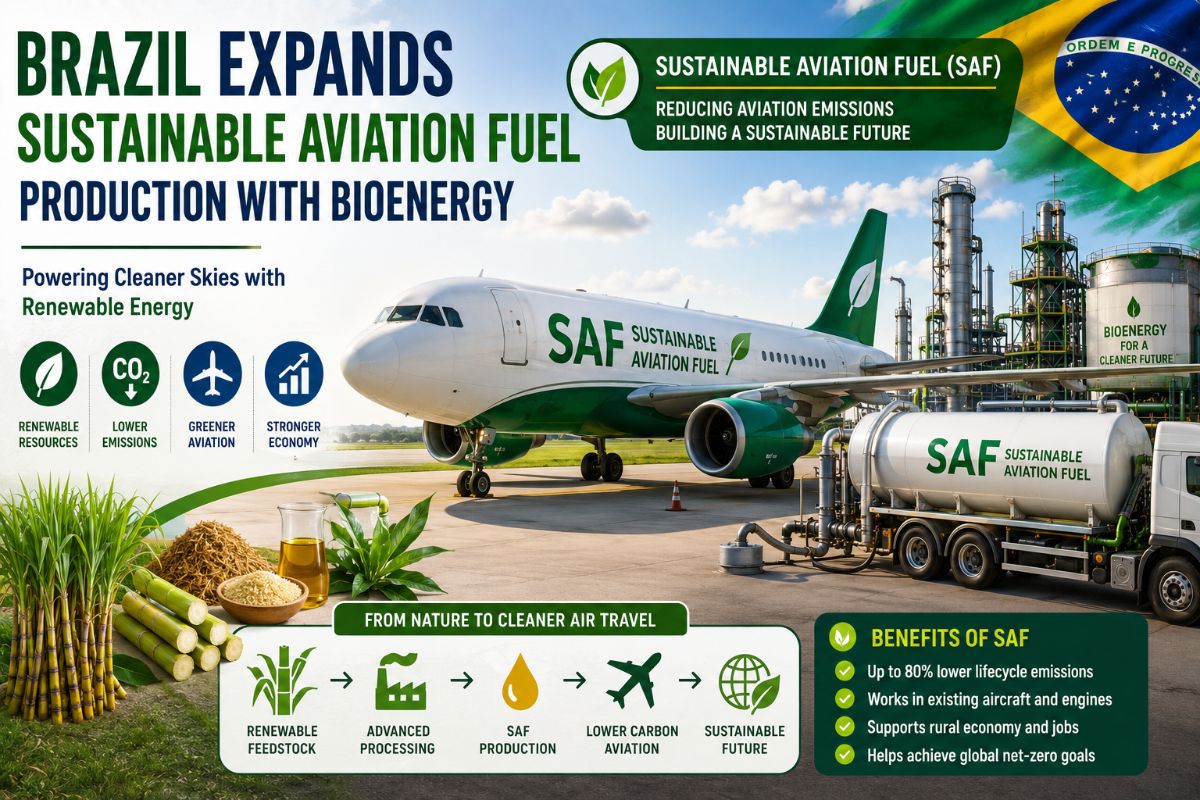
Brazil Expands Sustainable Aviation Fuel Production with Bioenergy
Brazil is strengthening its position as a global bioenergy leader by expanding the production of Sustainable Aviation Fuel (SAF). Leveraging abundant renewable resources such as sugarcane, agricultural residues, used cooking oil, and other biomass feedstocks, the country aims to reduce aviation emissions while creating new economic opportunities across the biofuel value chain.
As airlines and governments work toward net-zero aviation goals, Sustainable Aviation Fuel is becoming an important solution for lowering greenhouse gas emissions from air travel without requiring major changes to existing aircraft or airport infrastructure.
📌 Key Takeaways
- Country: Brazil
- Technology: Sustainable Aviation Fuel (SAF)
- Sector: Bioenergy & Aviation
- Primary Benefit: Reduces lifecycle greenhouse gas emissions from aviation.
- Applications: Commercial airlines, cargo aircraft, business aviation, and airport fuel supply.
💡 Did You Know?
Depending on the feedstock and production pathway, Sustainable Aviation Fuel can reduce lifecycle greenhouse gas emissions by up to 80% compared with conventional jet fuel.
What Is Sustainable Aviation Fuel?
Sustainable Aviation Fuel is an alternative aviation fuel produced from renewable resources instead of petroleum. It is designed to work with existing aircraft engines and fuel infrastructure while significantly reducing lifecycle carbon emissions.
How Sustainable Aviation Fuel Is Produced
- Renewable feedstocks such as sugarcane, biomass, agricultural waste, or used cooking oil are collected.
- The feedstock is processed using advanced biofuel technologies.
- Renewable hydrocarbons are refined into aviation fuel.
- The SAF is blended with conventional jet fuel according to approved standards.
- The blended fuel is supplied to airports and airlines.
- Aircraft operate using lower-carbon aviation fuel.
Why Brazil Is Investing in SAF
- Utilize abundant agricultural resources.
- Reduce aviation greenhouse gas emissions.
- Strengthen the national biofuel industry.
- Create new rural employment opportunities.
- Support international climate commitments.
- Expand clean fuel exports.
Benefits of Sustainable Aviation Fuel
- Lower lifecycle carbon emissions.
- Compatible with existing aircraft.
- Supports energy diversification.
- Creates additional markets for agricultural products.
- Improves aviation sustainability.
- Supports long-term net-zero goals.
Challenges
Large-scale SAF production requires significant investment, reliable feedstock supplies, advanced refining technologies, and supportive government policies. Increasing production capacity while maintaining sustainability standards remains an important priority.
Frequently Asked Questions
What is Sustainable Aviation Fuel (SAF)?
SAF is a renewable aviation fuel produced from sustainable feedstocks that reduces lifecycle greenhouse gas emissions compared with conventional jet fuel.
Can existing aircraft use SAF?
Yes. Approved Sustainable Aviation Fuel blends can be used in today's commercial aircraft without major engine modifications.
Why is Brazil ideal for SAF production?
Brazil has abundant biomass resources, a strong biofuel industry, extensive agricultural production, and decades of experience in renewable fuel technologies.
What feedstocks are used to produce SAF?
Common feedstocks include sugarcane, agricultural residues, used cooking oil, animal fats, forestry residues, and other sustainable biomass resources.
Does SAF eliminate aviation emissions?
SAF significantly reduces lifecycle greenhouse gas emissions but does not completely eliminate emissions. It is considered an important tool for decarbonizing aviation.
Which countries are investing in Sustainable Aviation Fuel?
Brazil, the United States, the United Kingdom, France, Singapore, Japan, Australia, and several European countries are investing in Sustainable Aviation Fuel production.
Recommended Renewable Energy Products

WAAREE II 580–585W TOPCon Bifacial Solar Panel
High-efficiency bifacial solar panel for residential, commercial, and utility-scale renewable energy installations.

Luminous NXG 1450e Solar Inverter
Reliable solar inverter for efficient renewable energy systems and dependable backup power.

Kenbrook Solar MC4 Crimping Tool Kit
Professional installation tool for secure MC4 connector assembly.

Pure Copper Lightning Arrester
Provides dependable lightning and surge protection for renewable energy systems.
Related SolSetu Articles
- Canada Expands Carbon Capture and Storage Projects to Reduce Industrial Emissions
- Saudi Arabia Accelerates Green Hydrogen and Renewable Energy Mega Projects
- Japan Develops Perovskite Solar Cells for Next-Generation Clean Energy
- Australia Builds Renewable Energy Zones to Accelerate Clean Power
Affiliate Disclosure: This article contains affiliate links. SolSetu may earn a commission from qualifying purchases at no additional cost to buyers.






Leave a Reply