
India’s Solar Jobs Boom: How Clean Energy Is Creating Millions of New Opportunities
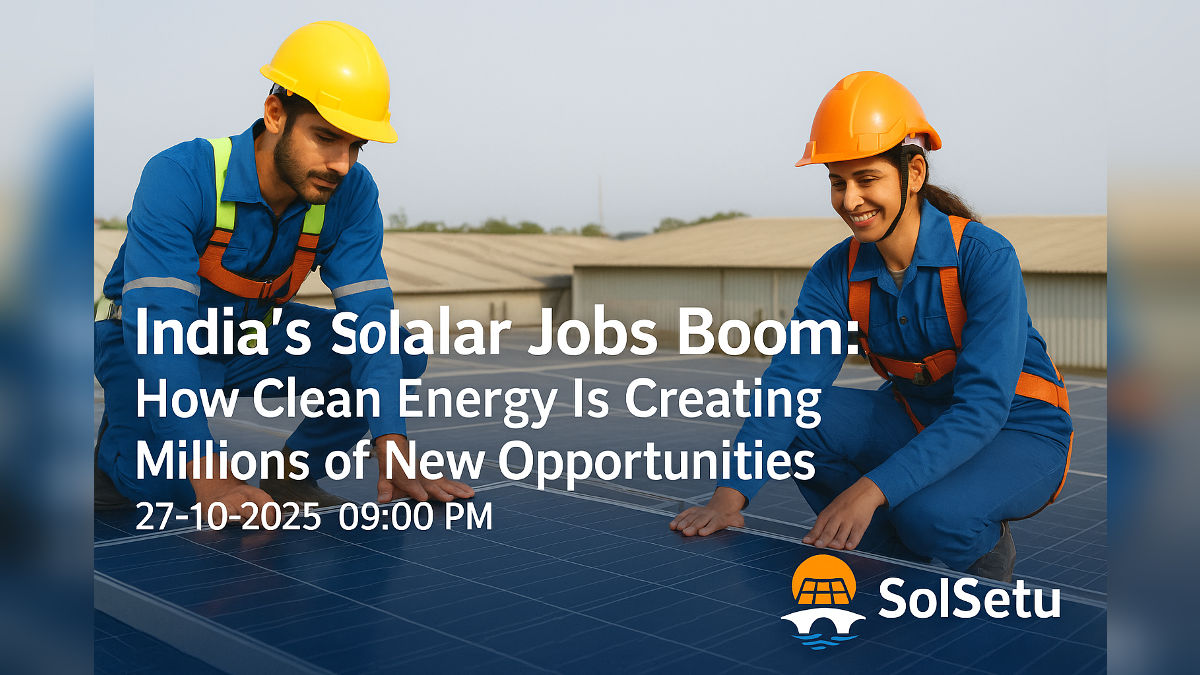
As India rapidly expands solar capacity in 2025, the resulting jobs boom is reshaping local economies — from manufacturing and construction to operations, digital services and rural entrepreneurship. This article maps the opportunities, the skills employers need, and the actions policymakers and educators must take to turn solar growth into durable livelihoods.
Where the jobs are being created
- Manufacturing & assembly: Module, inverter and balance-of-system manufacturing requires factory workers, quality engineers and procurement specialists as domestic capacity expands.
- EPC & construction: Installation crews, site supervisors, civil teams and logistics managers for rooftop, utility and floating projects.
- O&M & field services: Technicians for preventive and corrective maintenance, string-level diagnostics, and remote monitoring teams.
- Storage & battery services: Battery assembly, BMS technicians, and recycling/downcycling specialists as BESS deployment accelerates.
- Digital & analytics roles: Data engineers, asset managers, AI/ML engineers for predictive maintenance and yield optimisation platforms.
- Sales, financing & support: Business development, financing specialists, customer care for residential and MSME segments and RESCO operators.
Skills in demand
Employers are looking for a mix of technical and soft skills: electrical safety and basic power electronics for technicians; data literacy and telemetry handling for monitoring engineers; project management and procurement for EPC leads. Short, accredited modular training — focused on practical, hands-on experience — is proving most effective to place candidates quickly.
Women & youth: untapped potential
Women and young workers are increasingly entering the solar workforce through targeted skilling programmes, SHG-led EPC franchises, and community-level sales/installation models. Gender-smart hiring and flexible training schedules help remove barriers such as mobility and caregiving responsibilities.
How employers can recruit & retain talent
- Partner with local training institutes and polytechnics for apprenticeship pipelines.
- Provide certified, stackable training that leads to nationally recognised credentials.
- Offer clear career ladders — e.g., technician → senior technician → site supervisor → O&M manager.
- Use mobile-first learning modules and remote mentoring to upskill field technicians on the job.
Role of policy & finance
Government programmes (central and state) can accelerate workforce creation by funding skilling missions, incentivising manufacturers to set up training centres, and providing wage subsidies for first-time hires. Financial instruments that de-risk MSME and RESCO hiring — such as short-term working capital lines linked to performance — help firms scale payrolls quickly.
Future-proofing jobs: standards, safety and circularity
As the sector grows, enforceable safety standards, battery recycling regulations, and clear EOL (end-of-life) pathways will be essential to protect workers and create new downstream employment in recycling, refurbishment and second-life battery markets.
Regional impact
Solar manufacturing hubs and assembly clusters in Gujarat, Tamil Nadu, and Maharashtra are creating concentrated industrial employment, while distributed rooftop and rural solar programmes (including PM-KUSUM and microgrid pilots) are driving job creation in tier-2 and tier-3 towns. Localised hiring reduces migration pressures and spreads economic gains beyond metro corridors.
How to get started — for jobseekers
- Look for accredited short courses in PV installation, safety and BESS handling at local ITIs and private training partners.
- Seek apprenticeships with EPCs and RESCOs — these often lead to steady field roles and stipends during training.
- Women candidates should explore SHG and NGO-run solar skilling cohorts that offer placement support for community-based roles.
India’s solar jobs boom is more than a hiring story — it’s an opportunity to build robust, local economies that combine clean energy transition with inclusive employment. With coordinated action across industry, training providers and policy-makers, millions of quality, long-term jobs can be created while accelerating the nation’s decarbonisation goals.
Find solar jobs & training on SolSetu






Leave a Reply