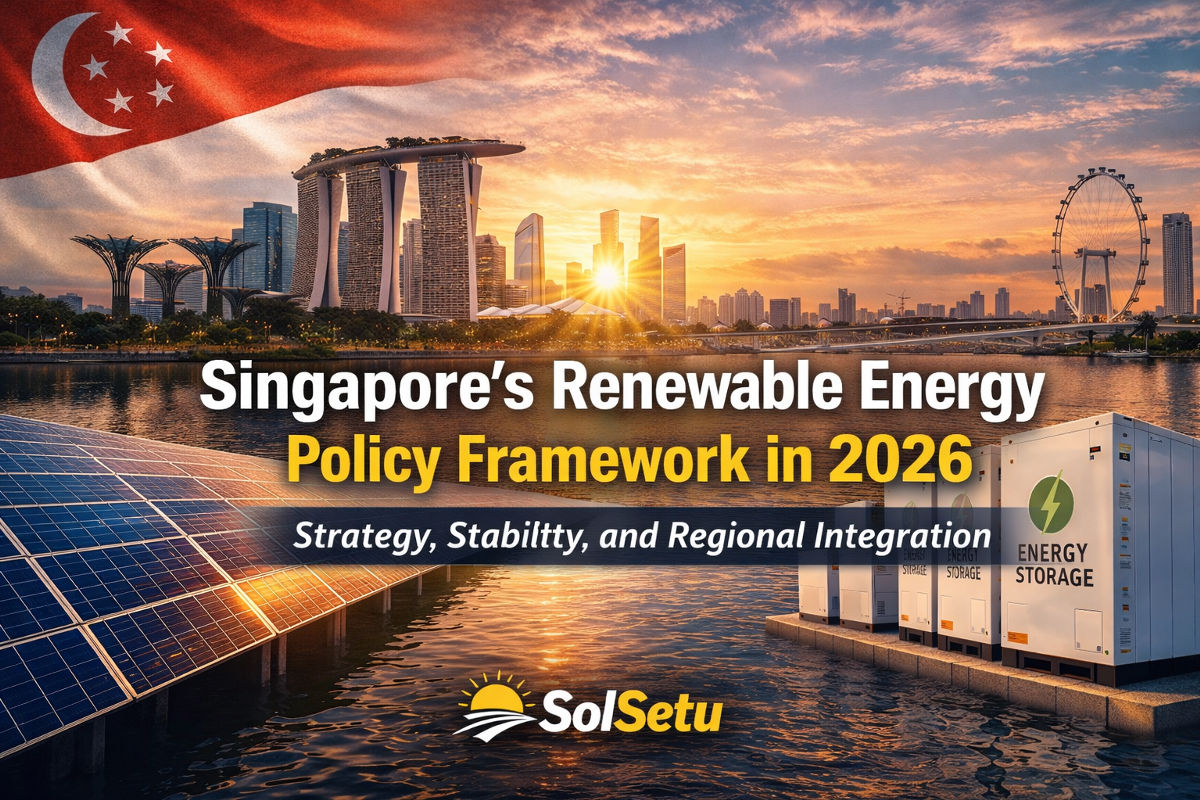
Singapore’s Renewable Energy Policy Framework in 2026: Strategy, Stability, and Regional Integration
Author: Girish | Published: 02 February 2026 | Platform: SolSetu
Singapore’s renewable energy strategy in 2026 reflects a distinctly pragmatic policy philosophy—one shaped by land scarcity, energy security imperatives, and regional cooperation. Rather than pursuing capacity-led expansion, the city-state continues to focus on system resilience, cross-border integration, and long-term decarbonization signals.
Solar Energy as the Domestic Anchor
Solar power remains Singapore’s primary domestic renewable resource. Policy emphasis continues on rooftop deployment, floating solar systems, and integration of photovoltaics into urban infrastructure. Public-sector leadership, standardized procurement models, and grid-ready interconnection frameworks have helped solar mature into a stable contributor within the national energy mix.
Rather than incentivizing speculative capacity growth, regulatory agencies prioritize reliability, performance transparency, and lifecycle efficiency.
Cross-Border Clean Power Imports
Recognizing structural limitations, Singapore’s 2026 energy policy places increasing importance on cross-border electricity imports. Regulatory frameworks supporting regional power trade within Southeast Asia are positioned as a cornerstone of long-term decarbonization.
Clean electricity imports—subject to strict certification, grid stability requirements, and contractual safeguards—are treated as strategic infrastructure rather than short-term supply instruments.
Carbon Pricing as a Policy Signal
Carbon pricing continues to function as a central policy lever in Singapore’s energy transition. Rather than direct subsidies, the government uses carbon cost signals to influence fuel choice, efficiency investments, and low-carbon technology adoption across industries.
This market-based approach aligns with Singapore’s broader fiscal discipline, ensuring decarbonization incentives remain economically grounded and predictable for long-term investors.
Energy Storage and Grid Intelligence
Energy storage, digital grid management, and demand-side flexibility are treated as system enablers rather than standalone technologies. In 2026, policy emphasis centers on enhancing grid responsiveness to variable supply—both domestic and imported—while maintaining Singapore’s high reliability standards.
Pilot programs, regulatory sandboxes, and controlled-scale deployments continue to guide technology validation before mass adoption.
What Singapore’s Model Signals for Asia
Singapore’s renewable energy policy offers a contrasting model to land-intensive expansion strategies seen elsewhere in Asia. Its approach prioritizes integration over scale, governance over volume, and regional cooperation over isolation.
For Asia-Pacific energy stakeholders, Singapore represents a blueprint for decarbonization under physical constraints—where policy clarity, regulatory consistency, and cross-border alignment define progress.



Leave a Reply