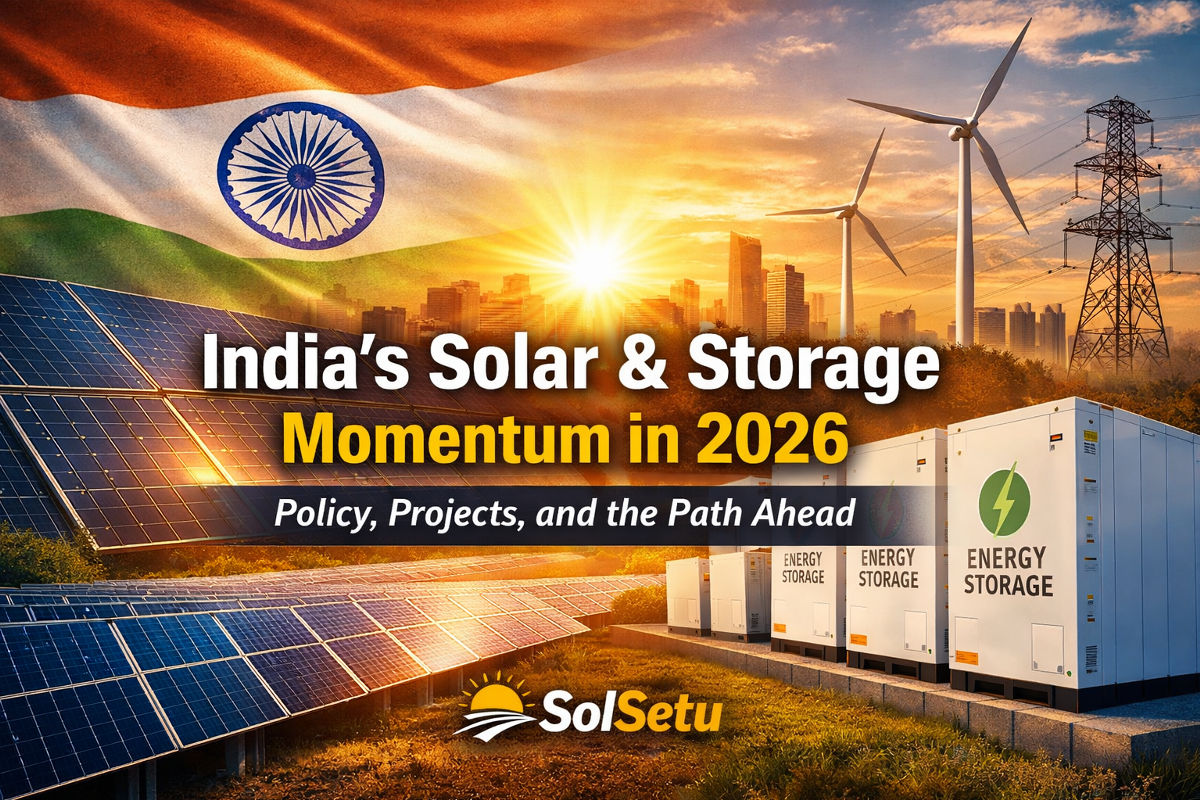
India’s Solar & Storage Momentum in 2026: Policy, Projects, and the Path Ahead
Author: Girish | Published: 02 February 2026 | Platform: SolSetu
As India enters 2026, the renewable energy landscape stands at a decisive inflection point. Solar power, once driven primarily by capacity targets, is now being shaped by grid integration, energy storage, and execution discipline. With policy continuity, rising investor confidence, and accelerating decentralization, the sector is evolving from ambition to operational maturity.
Policy Continuity Driving Market Confidence
Government-backed initiatives such as rooftop solar incentives, agricultural solarization, and hybrid renewable tenders continue to anchor market stability. Unlike previous cycles of abrupt regulatory shifts, 2026 reflects a more predictable policy environment—encouraging long-term planning by developers, EPC firms, and financial institutions.
This consistency has proven especially important for distributed solar segments, where residential and MSME adoption depends heavily on subsidy clarity, net-metering stability, and simplified approval processes.
Energy Storage Moves from Optional to Essential
One of the defining shifts of 2026 is the mainstreaming of energy storage. Battery Energy Storage Systems (BESS) are no longer pilot-scale additions but core components of utility-scale and commercial projects. As grid operators face variability challenges, storage-backed solar assets are increasingly favored in tenders and power purchase agreements.
While capital costs remain a consideration, improving battery economics and hybrid project bankability are steadily closing the viability gap.
Execution Realities: Land, Grid, and Capital
Despite strong momentum, execution challenges persist. Land acquisition timelines, evacuation infrastructure constraints, and rising financing costs continue to influence project economics. Developers in 2026 are responding by prioritizing site diligence, modular plant design, and early grid coordination.
Financial institutions, meanwhile, are placing greater emphasis on generation predictability, sponsor credibility, and long-term operational strategies rather than headline capacity alone.
The Rise of Verified Marketplaces and Transparency
As the solar ecosystem expands, transparency and trust have emerged as critical success factors. Buyers—ranging from homeowners to large industrial consumers—are increasingly seeking verified vendors, standardized project disclosures, and clear performance benchmarks.
This shift is accelerating the role of digital platforms that connect clients with credible solar vendors, manufacturers, and service providers under a unified discovery framework.
2026 and Beyond: From Growth to Grid Intelligence
India’s renewable journey is entering a phase defined not just by megawatts added, but by how intelligently energy is generated, stored, and consumed. Solar power in 2026 is no longer a standalone solution—it is part of an integrated energy ecosystem.
For stakeholders who adapt early to storage integration, execution discipline, and transparency-driven engagement, the coming years present not just growth, but durable leadership.




Leave a Reply