India Crosses 200 GW Renewable Energy Capacity in Late 2025, Solar Leads with Strongest Contribution
By SolSetu News Desk
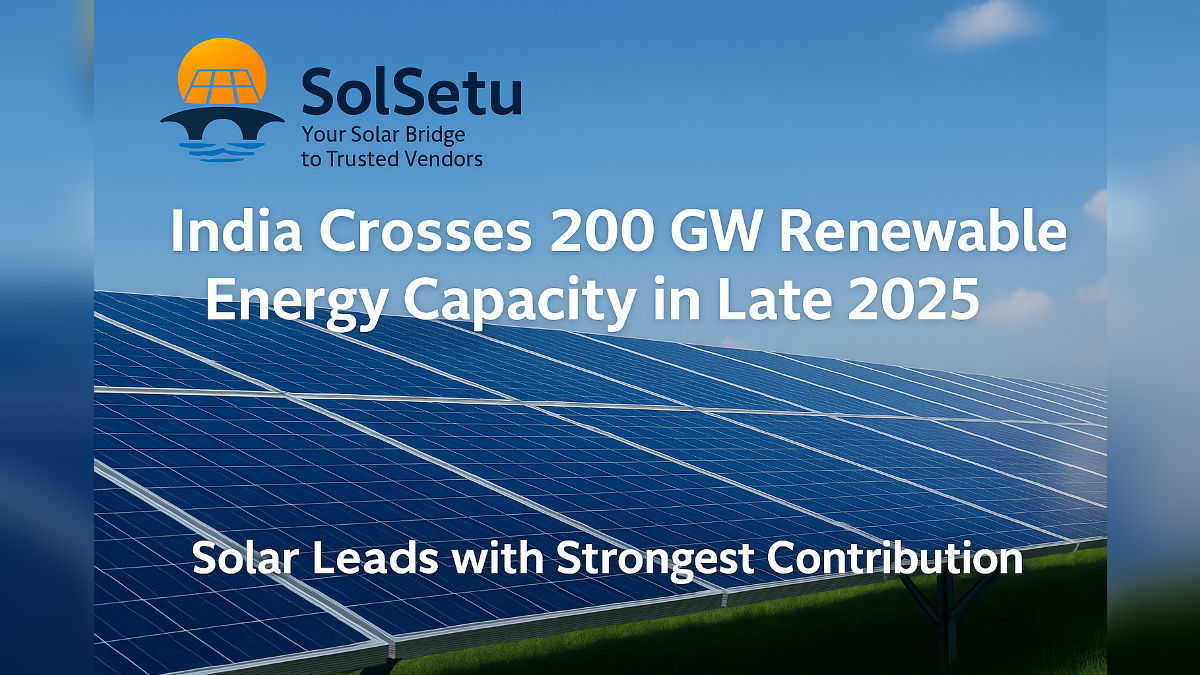
India has officially crossed the landmark figure of 200 GW in total renewable energy capacity in late 2025, according to preliminary industry and policy assessments tracked across central and state agencies. Solar energy continues to dominate the expansion, contributing nearly half of the new installed capacity added during the year.
The achievement marks a major step forward in India’s long-term clean energy roadmap and solidifies the country’s position as one of the fastest-growing renewable energy markets globally.
Solar Remains the Fastest Growing Segment
Solar installations—both rooftop and utility-scale—continue to lead India’s renewable transition. Analysts estimate that:
- Solar contributed over 60 GW to the 200 GW milestone
- Rooftop solar saw a strong surge due to subsidies and falling module prices
- Utility-scale parks in Rajasthan, Gujarat, Karnataka, and Maharashtra expanded rapidly
The rooftop solar segment alone added record capacity between Q2 and Q4 of 2025.
Wind & Hybrid Projects Also Gain Momentum
Alongside solar, wind and hybrid (solar + wind) projects saw strong policy backing. Key growth areas include:
- Wind repowering and hybrid tender expansion
- New transmission corridors for renewable zones
- Offshore wind announcements in Gujarat & Tamil Nadu
The combined hybrid capacity pipeline for 2026–2027 is expected to accelerate further grid integration.
Energy Storage, Green Hydrogen See Rising Interest
2025 also marked a notable rise in investments for:
- Battery Energy Storage Systems (BESS)
- Round-the-clock renewable supply contracts
- Green hydrogen pilot projects
This diversification is expected to support India’s next 100 GW renewable addition cycle.
Policy Push Continues
Government policies—including faster approvals, updated tender frameworks, and support for domestic manufacturing—played a key role in accelerating capacity addition.
Experts say India’s next major target—achieving 500 GW of non-fossil energy by 2030—looks increasingly achievable with the current momentum.
SolSetu will continue monitoring India’s clean energy progress and provide milestone updates as new data becomes available.




Leave a Reply