
Agrivoltaics in India: How Solar Panels Are Helping Farmers Grow More Than Crops
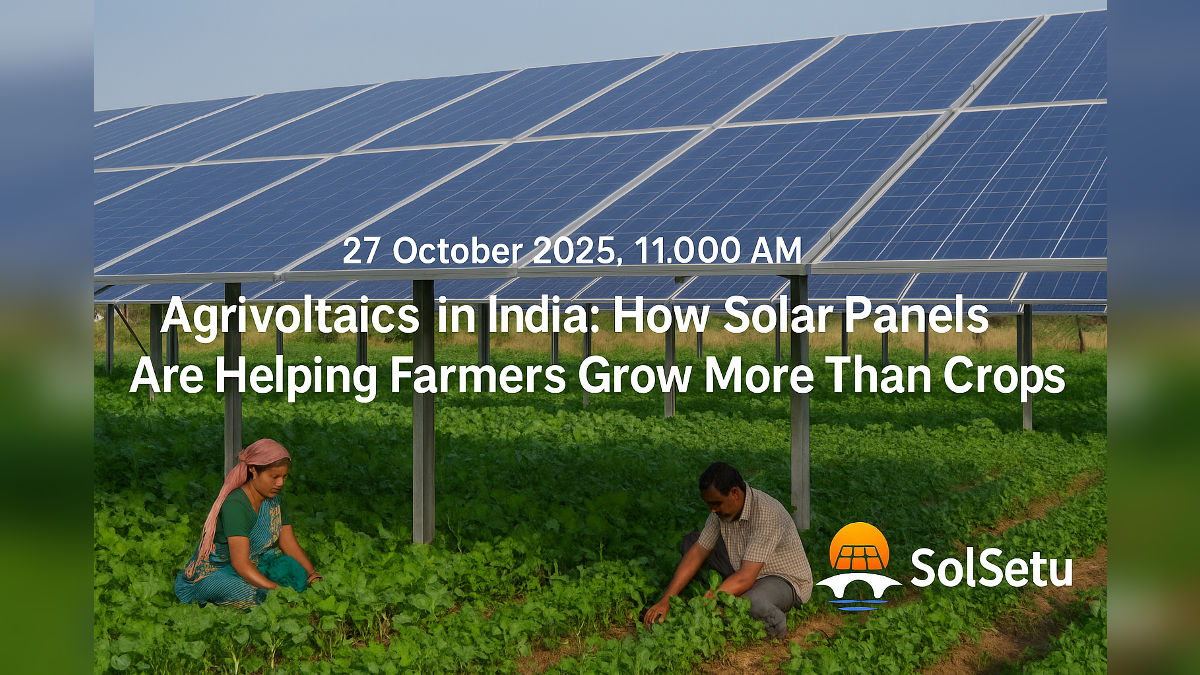
A new revolution is unfolding in India’s farmlands — one that combines sunlight, soil, and sustainability. Known as agrivoltaics, this practice allows farmers to grow crops beneath solar panels, earning dual income from both food and clean energy. In 2025, agrivoltaics is gaining ground under government programs like PM-KUSUM and private partnerships.
How agrivoltaics works
In an agrivoltaic setup, solar panels are mounted at an elevated height to let sunlight reach crops below. These panels provide partial shade, helping reduce heat stress on plants while generating renewable electricity. The dual land use increases land productivity up to 160%.
Government push under PM-KUSUM
Under the PM-KUSUM Yojana (Component C), farmers and cooperatives are encouraged to install decentralized solar plants on fallow land, earning from power sales to the grid. State agencies like MAHADISCOM and GEDA are offering simplified approvals and feed-in tariffs for such projects.
Benefits for farmers
- Dual income: Farmers earn from both electricity sales and crops.
- Crop protection: Panels reduce evaporation and heat stress.
- Water efficiency: Partial shading reduces irrigation needs by up to 20%.
- Improved soil health: Microclimate stability promotes microbial activity and yields.
Challenges and design considerations
- High upfront costs of elevated structures.
- Need for careful panel tilt and height to avoid crop shading.
- Lack of agronomic studies for Indian crop varieties under solar arrays.
Despite these challenges, partnerships between DISCOMs, EPCs, and farmer cooperatives are scaling agrivoltaic pilots. Startups are also offering modular, retractable solar structures for seasonal flexibility.
The road ahead
India aims to integrate agrivoltaics into 10% of future solar capacity by 2030. With over 60 million hectares of cultivable land, even 1% adoption could yield 100 GW of solar potential while supporting climate-resilient agriculture.
List your agrivoltaic project on SolSetu




Leave a Reply